 Self-cycleTM IVF


-
-
-
 Infertility Counselling
-
 Female Infertility Treatment
-
 Andrology Treatment
-
 Fertility Enhancing Surgeries - Female
-
 Fertility Enhancing Surgeries - Male
-
 Endoscopy Treatment
-
 IUI Treatment
-
 IVF Treatment
-
 ICSI Treatment
-
 Advance IVF Solutions
-
 Embryology
-
 Vitrification Egg, Embryo, Sperm Freezing
-
 Preimplantation Genetic Testing (PGT)
-
 Donation Program Embryo / Egg / Sperm
-
 Self-cycleTM IVF
-
-
-
-
-
Embryo Transfer Procedure: What Happens Step by Step and Is It Really Painful?

Nobody talks about embryo transfer day the way it actually feels. You have survived the injections, the retrieval, the phone calls from the embryology lab, and now you are sitting in a waiting room wondering if this final step is going to hurt.
Many patients come in with the misconception that embryo transfer is painful, but it is not. Here is what actually happens from the moment you walk in.
What Is an Embryo Transfer and When Does It Happen in IVF?
Embryo transfer is the final stage of IVF treatment. After the eggs are fertilised, the embryos undergo growth in the laboratory for several days, and the chosen embryo is transferred to the woman's womb. Normally, the process is performed on day 5, when the embryo becomes a blastocyst.
Blastocysts have a higher implantation rate than day 3 embryos, and therefore, clinics opt for this period.
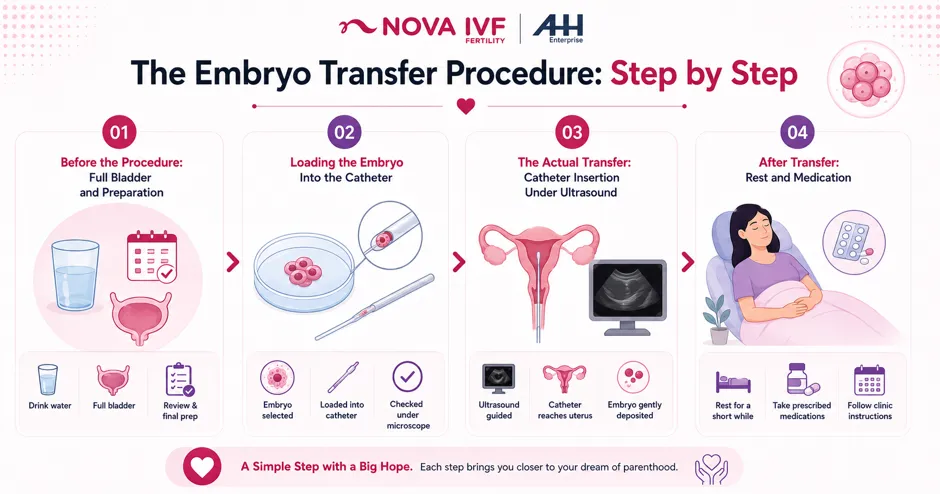
The Embryo Transfer Procedure: Step by Step
The procedure follows a few steps, where each step is designed to increase accuracy and cause less discomfort:
Before the Procedure: Full Bladder and Preparation
Patients are requested to come for the egg transfer procedure with a full bladder. This helps the doctor see the uterus clearly on ultrasound during the transfer. If you are anxious, a mild sedative can be given, but it is not routinely needed.
Before the transfer begins, the role of the embryologist in IVF is to carefully load the selected embryo into the catheter, ready for the doctor to proceed.
The Actual Transfer: Catheter Insertion Under Ultrasound
The doctor uses a speculum to visualise the cervix, then guides the soft catheter through the cervical opening into the uterine cavity under continuous abdominal ultrasound guidance.
The embryo is released with a gentle push of the syringe. The catheter is then checked under the microscope to confirm the embryo has been successfully delivered.
After Transfer: Rest and Medication
Following the transfer, the patient rests briefly in the clinic for 15 to 30 minutes. Progesterone support is prescribed to maintain uterine lining quality. Most patients return to light activity the same day.
To understand what happens next at the cellular level, how long implantation takes after embryo transfer is a question many couples have, and the answer typically falls within 6 to 10 days post-transfer. A beta-hCG blood test is scheduled about 14 days later to confirm pregnancy.
Is Embryo Transfer Painful? What Women Actually Feel
For most patients, the embryo transfer procedure is not painful. A brief cramp may be felt as the catheter passes through the cervix, and mild pressure from the speculum is common.
If you experience mild cramping after the procedure, it is completely normal and could be due to the progesterone medication. However, if you are experiencing severe symptoms like heavy cramps, bleeding or fever, it is recommended that you consult your fertility specialist.
Factors That Affect Embryo Transfer Success
Not every egg transfer procedure leads to a successful pregnancy, which means it does not always come down to luck. The following things affect the embryo transfer procedure success:
- Embryo quality: The higher the embryo quality, the greater its ability to successfully implant into the uterus.
- Uterine lining: The lining needs to be at least 7mm thick with a triple-layer pattern. Anything below that and the embryo has less to work with.
- Transfer technique: A steady hand and ultrasound guidance make a real difference in where exactly the embryo lands.
- Your age at egg retrieval: This matters more than your age on transfer day. The eggs used to create the embryo are what count.
FAQs
How long does the embryo transfer procedure take?
The in-room procedure takes about 10 to 15 minutes. Including preparation and post-transfer rest, patients should plan for approximately 60 to 90 minutes at the clinic.
Should I have a full bladder for embryo transfer?
You need a full bladder because it moves the uterus to the right position making it easy for doctors to visualise the uterus using ultrasound during the embryo transfer process.
What should I avoid on the day of embryo transfer?
You are supposed to avoid strenuous exercise or stressful activities on the same day. Your doctor will provide you with instructions specific to your case.
How many embryos are transferred in one IVF cycle in India?
The number of embryos transferred varies among patients. However, as per the guidelines issued by the Indian Council of Medical Research (ICMR), one embryo is transferred in most cases where the woman is below 35 years old.