 Self-cycleTM IVF


-
-
-
 Infertility Counselling
-
 Female Infertility Treatment
-
 Andrology Treatment
-
 Fertility Enhancing Surgeries - Female
-
 Fertility Enhancing Surgeries - Male
-
 Endoscopy Treatment
-
 IUI Treatment
-
 IVF Treatment
-
 ICSI Treatment
-
 Advance IVF Solutions
-
 Embryology
-
 Vitrification Egg, Embryo, Sperm Freezing
-
 Preimplantation Genetic Testing (PGT)
-
 Donation Program Embryo / Egg / Sperm
-
 Self-cycleTM IVF
-
-
-
-
-
ICSI vs IVF: Understanding the Key Differences
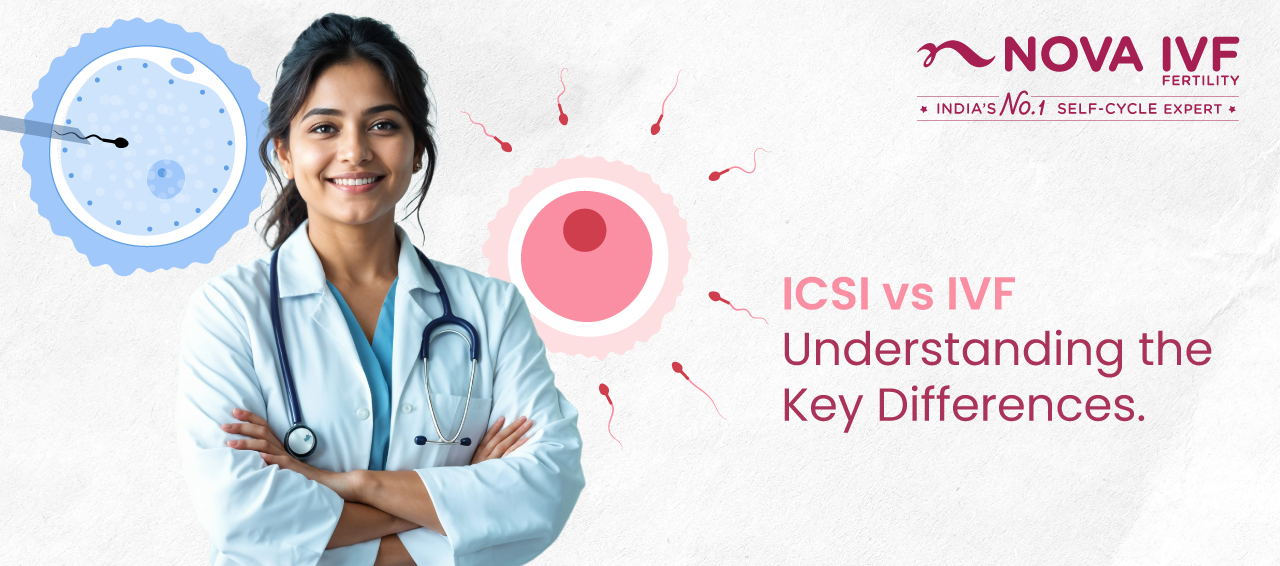
For couples who are having trouble having a child naturally, advanced fertility treatments —assisted reproductive technologies (ARTs) such as intracytoplasmic sperm injection (ICSI) and in vitro fertilisation (IVF) provide promising solutions. Even though both treatments aim to help you become pregnant, they are different in terms of method and suitability for different fertility problems. Understanding the difference between IVF and ICSI can allow you to make an educated choice about which option is right for you. This page delves into ICSI vs IVF, discussing their procedures, their benefits, and more. By the end, you will have a solid grasp of the differences between IVF and ICSI, allowing you to make the right choice.
Key Takeaways
ICSI vs IVF is a common fertility treatment comparison for couples exploring assisted reproductive techniques. In IVF vs. ICSI, the difference is the fertilisation method. In IVF, the egg is kept with sperm in the lab. In ICSI, fertilisation is done by injecting a single sperm into the egg using the ICSI procedure. This method is often used in male infertility IVF cases or when fertilisation failure is a concern. In this blog, we explain IVF vs. ICSI, who needs which option, and the basic differences clearly.
What is IVF (In Vitro Fertilisation)?
IVF, or in vitro fertilisation, is a widely used treatment option for couples facing difficulty conceiving, including those with unexplained infertility, blocked fallopian tubes, or ovulatory issues. It consists of a series of set procedures. A complete IVF cycle takes approximately three weeks.
Following are the steps in IVF:
- Ovarian stimulation: Medications are administered for 7-10 days for stimulating the ovaries and generating more eggs.
- Egg retrieval: Mature eggs are first extracted from the ovaries through a minor surgical procedure. Meanwhile, sperm from the male partner are obtained and prepared.
- Fertilisation: In a controlled setting, i.e., an IVF lab, the egg and sperm are fertilised to form an embryo. Alternatively, a donor sperm or egg can be used for fertilisation, depending on the specific case.
- Embryo transfer: The resultant embryo obtained through lab fertilisation is then inserted in the uterus for implantation to occur.
What is ICSI (Intracytoplasmic Sperm Injection)?
ICSI, or intracytoplasmic sperm injection is a specialised type of IVF in which a single sperm is directly injected into an egg for fertilisation to occur. This method can be especially effective for couples dealing with severe male factor infertility issues. The steps in ICSI are much like those in IVF, with an important modification during fertilisation.
- Ovarian stimulation and egg retrieval: Similar to IVF, medicines are administered for stimulating the ovaries, and eggs are retrieved.
- Sperm selection: An embryologist carefully selects one healthy sperm. At this point, advanced fertility techniques like Magnetic-Activated Cell Sorting (MACS) and ZyMot may be applied to enhance selection.
- Micromanipulation: This involves inserting the chosen sperm precisely into the egg with an extremely small needle.
- Fertilisation: In a controlled setting, i.e., an IVF lab, the egg and sperm that is inserted is allowed to fertilise to form an embryo.
- Embryo transfer: The fertilised egg (embryo) is then implanted into the uterus.
Read About our ICSI treatment program
Difference Between ICSI and IVF
Although both IVF and ICSI are types of assisted reproductive technologies (ART) and share some similarities, there are differences between them. The table below highlights IVF vs ICSI for ease of understanding the basic difference between them:
| Factors | IVF | ICSI |
|---|---|---|
| Method of fertilisation | Eggs and sperm are mixed naturally in a petri dish. | Only one sperm is inserted directly into an egg. |
| Suitable for | unexplained infertility, obstructed fallopian tubes, mild male infertility | Severe male factor infertility, low sperm count, or motility |
| Risk of Fertilisation Failure | Higher owing to reliance on the natural ability of sperm | Lower since the sperm is directly injected |
| Sperm Quality/Quantity | During IVF, more sperm are required | ICSI requires a small amount of sperm for fertilisation. |
| Cost | Usually, lower compared to ICSI. | Slightly higher cost due to specialised procedures. |
While IVF vs ICSI success rates depend on a lot of factors, ICSI is frequently recommended when standard IVF fails or there is male factor infertility present.
Conclusion
To summarise, both ICSI and IVF are effective methods for helping couples who are having difficulty conceiving, but they work in very distinct ways and can be used for different reasons. IVF combines sperm and eggs in a laboratory dish, allowing for natural fertilisation. ICSI, on the other hand, injects only one sperm into an egg, bypassing any issues that may arise during fertilisation. These methods are selected based on the individual's fertility issues. ICSI is typically utilised for severe male infertility, but IVF is often utilised to address both female and male infertility effectively. Individuals and couples may select better reproductive treatment options if they understand the ICSI and IVF difference.
Learn More About IVF treatment process at Nova IVF Fertility
FAQs
1. In ICSI vs IVF, which one is better?
It depends on the diagnosis. IVF is used in a wide array of infertility cases among men and women, while ICSI is mainly chosen for male infertility situations.
2. What is the main difference between “IVF vs ICSI”?
In IVF, fertilisation happens naturally in the lab dish. In ICSI, one sperm is injected into the egg using the ICSI procedure.
3. Are ICSI vs. IVF success rates the same?
In many couples, ICSI vs. IVF success rates are similar. Results depend more on egg quality and age.
4. Is the cost higher for ICSI?
No. IVF costs are usually higher because it often requires additional lab micromanipulation beyond the ICSI procedure itself.
5. When is ICSI treatment vs IVF recommended?
The ICSI treatment is usually recommended when sperm count or motility is very low or fertilisation failure has occurred in a previous IVF cycle. IVF is broader and can be used in unexplained infertility as well.
6. IVF vs ICSI: Which one is better?
This depends on the cause of infertility and whether to utilise IVF or ICSI. IVF is best suited for both female and male infertility issues, whereas ICSI is more frequently recommended for severe male infertility. Your IVF specialist will be the best person to guide you on this, depending on your specific case.
7. What's the main distinction between ICSI and IVF?
The main distinction between ICSI and IVF is that in ICSI, a single sperm is injected directly into an egg, whereas in IVF, sperm and eggs combine naturally in an advanced lab setting.
8. When should ICSI be used instead of standard IVF, and when should it not?
The choice between standard IVF and ICSI is based on a number of factors, and fertility experts give recommendations after a thorough review of the couple's specific circumstances.
9. Is ICSI more expensive than IVF?
Yes, ICSI is generally more expensive than IVF because of the additional micromanipulation procedures needed during fertilisation.
10. Are there any risks associated with IVF and ICSI?
Although both ICSI and IVF are safe treatments, as with any procedure, there are certain risks. Multiple pregnancies, ovarian hyperstimulation syndrome (OHSS), and emotional stress, among others are all potential risks of IVF and ICSI.