 Self-cycleTM IVF


-
-
-
 Infertility Counselling
-
 Female Infertility Treatment
-
 Andrology Treatment
-
 Fertility Enhancing Surgeries - Female
-
 Fertility Enhancing Surgeries - Male
-
 Endoscopy Treatment
-
 IUI Treatment
-
 IVF Treatment
-
 ICSI Treatment
-
 Advance IVF Solutions
-
 Embryology
-
 Vitrification Egg, Embryo, Sperm Freezing
-
 Preimplantation Genetic Testing (PGT)
-
 Donation Program Embryo / Egg / Sperm
-
 Self-cycleTM IVF
-
-
-
-
-
Endometrial Thickness for IVF: Key Factors & How to Improve It
Why Does the Thickness of the Endometrium Matter?
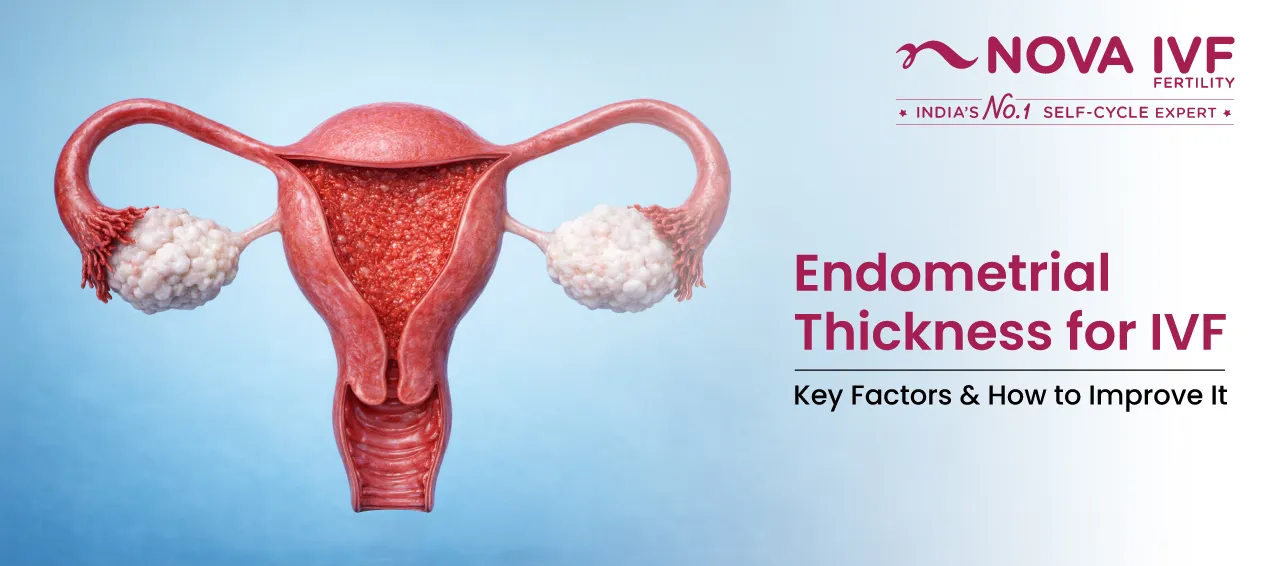
In IVF, the embryo is placed inside the uterus, so the lining needs to be ready at that time. That is why endometrial thickness for IVF is considered an important checkpoint before embryo transfer. If the lining is thin, implantation may become more difficult, and pregnancy rates may drop.
Sometimes the problem is not just the number on the scan. The lining may not grow well because estrogen levels are low or because the uterus is not getting enough blood supply. A better-developed lining generally gives the embryo a better chance of settling and implanting. That is why doctors continue to check endometrial thickness throughout the IVF cycle and may increase or adjust hormone support if the lining is still not improving. Thickness is not the only thing that affects IVF success, but it is one of the practical signs doctors rely on when deciding whether it is the right time to go ahead with embryo transfer.
How Is Endometrial Thickness Measured?
A common question during fertility treatment is “What is endometrial thickness?” and how it is checked. In most cases, it is measured using a transvaginal ultrasound. This scan allows the doctor to clearly see the uterus and measure the lining in millimetres. The procedure is usually simple, takes only a few minutes, and is performed multiple times during an IVF cycle to track how the lining responds to hormones. Along with the number, doctors also check the endometrial pattern, because a healthy lining is often more important than a single measurement. In rare situations, if ultrasound results are unclear or uterine anatomy needs a closer look, further evaluation may be recommended.
Are There Cases Where Endometrial Thickness is Not a Concern for IVF Success?
Yes. Endometrial thickness matters in IVF, but it does not determine the outcome on its own. Doctors see many cycles where the lining is not “perfect” on paper, but pregnancy still happens because other things are working in the patient’s favour.
- If the embryo quality is good, pregnancy can still happen even when the endometrial thickness is slightly on the lower side.
- If the ultrasound shows a healthy lining pattern, doctors may not treat a borderline measurement as a major issue.
- If a woman has conceived earlier with a similar lining thickness, the same range may still be acceptable in the current cycle.
- In frozen embryo transfer cycles, the lining is often prepared more deliberately with hormone support.
- If uterine blood flow appears normal on the scan and hormones are functioning as they should, doctors may not give too much weight to thickness alone.
- If the uterus appears normal and there are no fibroids, polyps, or adhesions, a slight lining difference is not always a cause for concern.
Thickened endometrial treatment is important, but doctors also consider embryo quality and overall ultrasound findings before finalising the embryo transfer.
FAQs
1. What is endometrial thickness?
In IVF scans, doctors check your uterus lining. Doctors call this measurement endometrial thickness for IVF. If the lining is better developed, implantation is usually easier.
2. What is a good endometrial thickness for IVF?
A good endometrial thickness in IVF is usually 8-12 mm.
3. Is a 7 mm lining enough for IVF transfer?
Often yes, but doctors also check the lining pattern and blood flow.
4. What are the symptoms of endometrial thickness being low?
Common symptoms of endometrial thickness issues include light periods or irregular cycles.
5. What are the causes of endometrial thickness not increasing?
Common causes of endometrial thickness problems include low estrogen, poor blood flow, or uterine scarring.
6. How to increase endometrial thickness for IVF?
The options for increasing endometrial thickness may include estrogen support, improved blood flow, and cycle adjustments.
7. Can IVF work with a thin endometrium?
Yes. It can still work, but the chances may be lower if the lining is consistently thin.
8. Does endometrial thickness for IVF matter in frozen cycles?
Yes. Endometrial thickness is important in IVF frozen transfer cycles as well.
9. Can endometrial thickness change every cycle?
Yes. It can be different from one cycle to another.
10. When is thickened endometrium treatment needed?
Thickened endometrium treatment is needed if doctors suspect abnormal thickening, polyps, or hormonal imbalance.