 Self-cycleTM IVF


-
-
-
 Infertility Counselling
-
 Female Infertility Treatment
-
 Andrology Treatment
-
 Fertility Enhancing Surgeries - Female
-
 Fertility Enhancing Surgeries - Male
-
 Endoscopy Treatment
-
 IUI Treatment
-
 IVF Treatment
-
 ICSI Treatment
-
 Advance IVF Solutions
-
 Embryology
-
 Vitrification Egg, Embryo, Sperm Freezing
-
 Preimplantation Genetic Testing (PGT)
-
 Donation Program Embryo / Egg / Sperm
-
 Self-cycleTM IVF
-
-
-
-
-
IUI Success Rate: What Are Your Real Chances of Getting Pregnant?
The IUI success rate is observed to be reported as roughly 8 to 15 percent pregnancy per cycle. A 2018 review in Human Reproduction Update by Cohlen and colleagues recorded a European delivery rate of about 8.3 percent per cycle. Results vary widely by age and diagnosis.
Intrauterine insemination, or IUI, places washed sperm into the uterus near ovulation, when the ovary releases an egg. For couples who have been trying for a while, the wide spread of quoted figures can be confusing. Age, tube health, and sperm quality each move the number
What Is IUI and How Does It Work?
IUI places washed, concentrated sperm directly into the uterus around the time of ovulation. This shortens the distance the sperm must travel to reach the egg. Because the IUI procedure supports natural fertilisation rather than replacing it, the underlying cause of infertility strongly shapes the result.
Why Doctors Often Try IUI First
Doctors often consider IUI before IVF, short for in vitro fertilisation, because it is simpler and cheaper. It uses the couple's own eggs and sperm where possible. IUI suits unexplained infertility, mild male-factor problems, and donor sperm, provided at least one fallopian tube stays open.
Donor sperm use in India is regulated under the Assisted Reproductive Technology (Regulation) Act 2021. The Act sets conditions for donor screening and consent. A fertility specialist confirms eligibility before a donor cycle begins.
How the Procedure Is Done
Staff wash the semen sample to concentrate the most motile sperm. A thin catheter then carries the sample into the uterus, and the visit takes only a few minutes. Knowing the timing of the fertile window keeps the insemination on schedule.
Because IUI supports conception rather than forcing it, the result leans on egg quality, tube health, and sperm quality. A single website average means little for any one couple. The figure that matters comes from a patient's own tests, read with a fertility specialist.
What Is the Average IUI Success Rate?
The average IUI success rate sits near 8 to 15 percent per cycle, and it depends heavily on age and diagnosis. Reported figures come from different populations, so they do not all measure the same thing. A full fertility assessment gives a better estimate than any single average.
Some numbers describe one cycle, while others add up several cycles, which is a common source of confusion. A study of younger women with unexplained infertility will report a higher figure than one that includes women over 40. Whether ovulation medicine was used also shifts the reported rate.
| Study population | Reported rate | Basis | Source |
|---|---|---|---|
| European register, all infertility causes | About 8.3 percent | Delivery per cycle, partner sperm | Human Reproduction Update, 2018 (Cohlen et al.) |
| 758 couples, 1,437 cycles, all causes | About 19.4 percent | Cumulative across cycles | Archives of Gynecology and Obstetrics, 2022 (Zippl et al.) |
| 300 Indian couples, first IUI cycle | About 17.3 percent | Clinical pregnancy at first cycle | Journal of Obstetrics and Gynaecology of India, 2014 (Panda et al.) |
Note: The insemination figure quoted online is almost always the per-cycle rate, not the cumulative total.
IUI Success Rate Per Cycle vs Cumulative Success
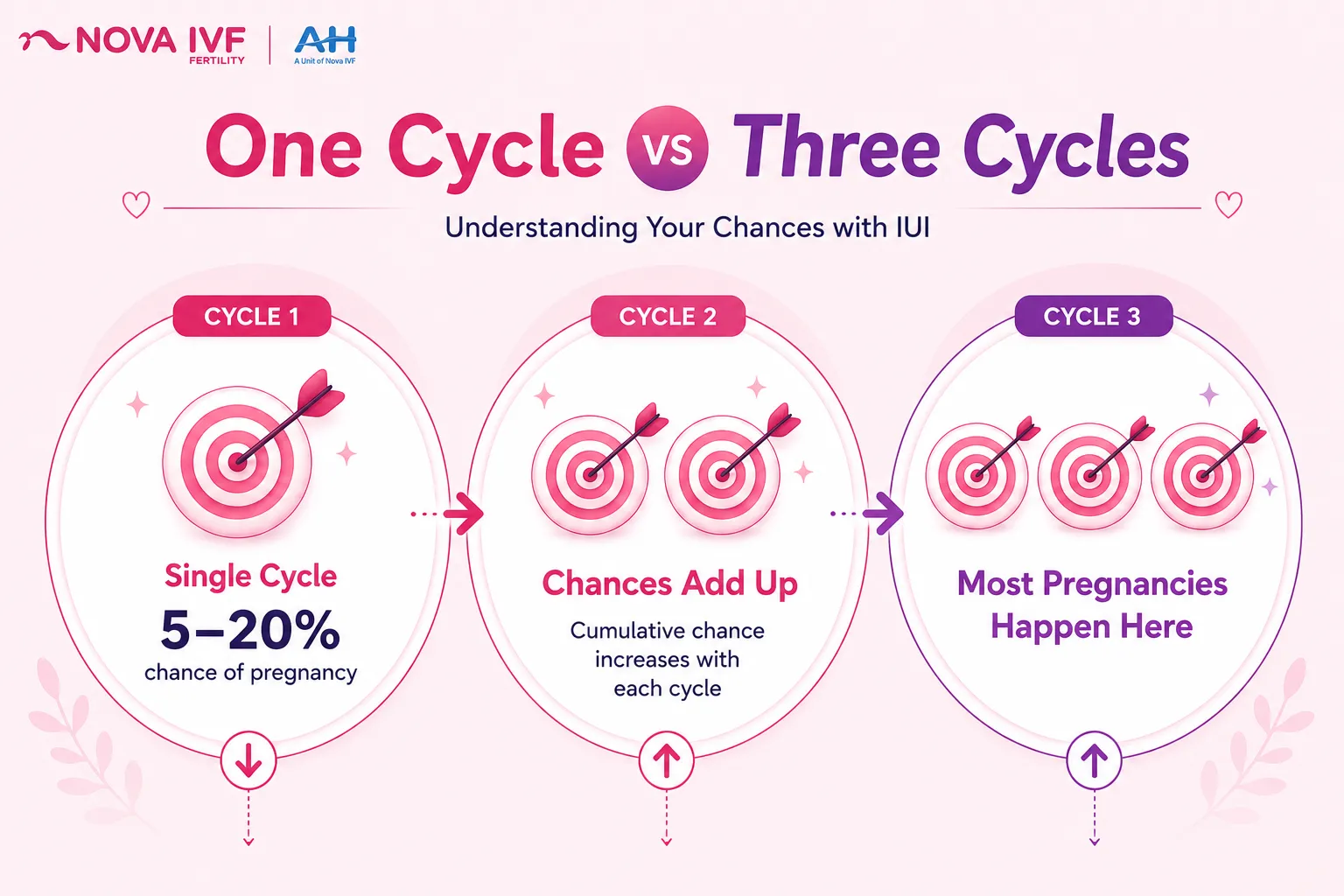
The IUI success rate per cycle is the chance of pregnancy in one treatment attempt. Cumulative success counts a pregnancy from any attempt in the series, so it always exceeds the single-cycle figure. Most pregnancies occur within the first three to four cycles.
Note: The insemination success rate quoted online is almost always the per-cycle figure.
- One cycle offers a modest chance for women who are suitable candidates.
- The cumulative chance rises across the first three to four cycles, where most cases of pregnancies are observed.
- A 2022 study in Archives of Gynecology and Obstetrics, covering 1,437 cycles in 758 couples, reported an overall cumulative pregnancy rate of about 19 percent, while best-prognosis couples reached nearly 45 percent after three cycles.
- The 2018 Human Reproduction Update review reported cumulative delivery of about 18 percent after three cycles, rising to roughly 30 percent by six cycles.
- Benefit slows after the fourth cycle, so doctors usually review the plan at that stage.
Cumulative figures still hinge on the cause of infertility, so they remain guides rather than promises. The step-by-step IUI process stays the same each time, so the rising cumulative chance reflects repeated attempts, not a new technique. Age and diagnosis, not the count of tries, cap that figure.
IUI Success Rate by Age: How Much Does Age Matter?
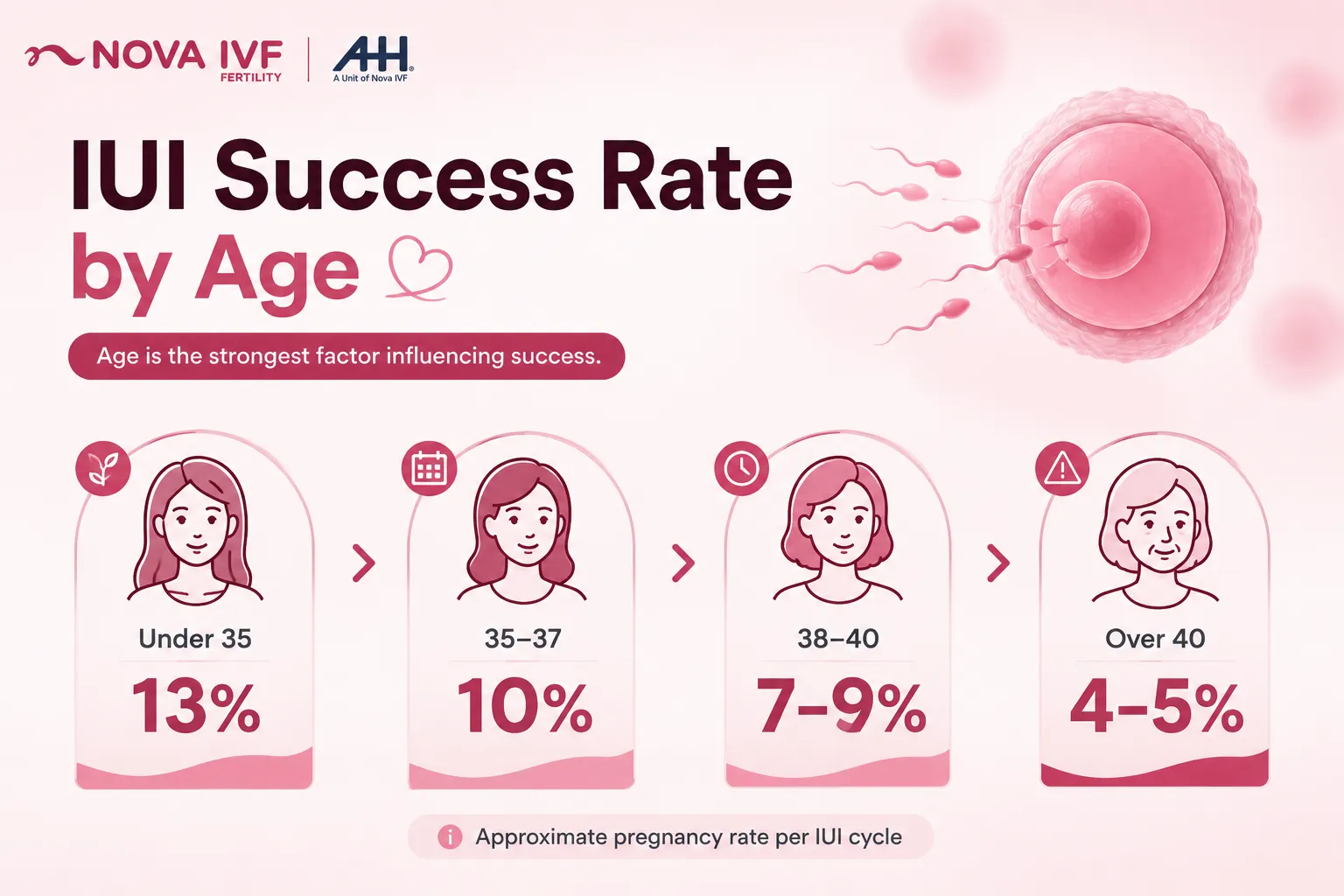
Age is the strongest single factor in the IUI success rate by age, because egg quality declines faster than egg number. Per-cycle rates stay fairly steady up to about age 40. After 40 they fall sharply, to roughly 4 to 5 percent per cycle.
The age-banded figures below are approximate per-cycle ranges that vary by centre, sperm quality, and protocol. They are illustrative rather than drawn from any single registry. The 2018 Human Reproduction Update review identified female age as the dominant predictor of IUI outcome.
| Age group | Pregnancies per cycle (approx.) | What it means |
|---|---|---|
| Under 35 | About 13 percent | A sensible first choice |
| 35 to 37 | About 10 percent | Still useful, watch the cycle count |
| 38 to 40 | About 7 to 9 percent | Saving time starts to matter |
| Over 40 | About 4 to 5 percent | IVF is often the better use of time |
A normal egg count at 41 is not expected to match the average outcome seen at 32, because egg quantity and quality decline on different timelines. Factors beyond age include ovarian reserve, the number of eggs remaining. These figures describe groups, not any single patient.
When Age Means Moving Past IUI
For many women over 38 to 40, repeated IUI can use up months they may not have. An open talk about whether IVF is faster belongs here, not later. Matching the treatment to the time available is the real goal.
Age alone does not decide the outcome. A woman under 35 with open tubes and a normal sperm test has a strong first-line case for IUI. Many such women conceive within the first few cycles.
Key Factors That Affect IUI Success Rate
Beyond age, a few clinical factors decide whether IUI is likely to work. Most are checked before the first cycle. One IUI pregnancy after secondary infertility, conceiving again after an earlier birth, shows what happens when these factors line up.
Female-Side Factors
Open fallopian tubes, regular ovulation, and a healthy egg supply form the base. IUI still relies on natural fertilisation inside the tube, so these matter. Endometriosis, where tissue like the womb lining grows outside it, and tube damage both lower the chances.
Male-Side and Shared Factors
Sperm count, movement (motility), and shape (morphology) all affect the result. Mild sperm problems are treatable and not a fault to blame. Many respond well once the sperm is washed and concentrated, with correct timing and a healthy womb lining.
Timing ovulation is one of the few things a couple can control. An ovulation tracking tool helps find the fertile days between clinic visits. The remaining factors are checked during testing and guide whether IUI or IVF fits better as a first step.
- At least one open, healthy fallopian tube, confirmed by a scan or dye test.
- Clear evidence of ovulation, either natural or supported by medicine.
- A semen sample that shows enough motile sperm after washing.
- An endometrial lining and cavity that appear ready for implantation.
Does Fertility Medication Improve IUI Success?
Ovulation-stimulating medicine is associated with a higher per-cycle chance for many patients. It also carries a risk of twins or higher-order pregnancy, which needs close monitoring. The aim is one or two mature eggs, not as many as possible.
Tablets
Letrozole and clomiphene are the usual first-choice tablets. Both gently encourage the ovary to release a mature egg on time. If you have polycystic ovary syndrome, or PCOS, your doctor may prefer letrozole.
Letrozole tends to lead to fewer twins than clomiphene. So the choice is matched to your diagnosis, rather than applied as a fixed rule. Your doctor will talk you through why one suits your situation better.
Comparative Evidence and Monitoring
It can help to know these choices rest on good evidence. The AMIGOS trial, published by Diamond and colleagues in the New England Journal of Medicine in 2015, looked closely at this question. Couples with unexplained infertility used these medicines with IUI, and the women were up to about 40.
Over up to four cycles, the cumulative live birth rate was about 19 percent with letrozole, 23 percent with clomiphene, and 32 percent with gonadotropins. Gonadotropins also led to noticeably more twin and triplet pregnancies. However these instances can potentially carry real added risks for both mother and babies.
Because of this, many doctors favour letrozole for unexplained infertility. They accept a slightly lower birth rate in return for fewer twins and triplets.
How Your Cycle Is Monitored
A 2022 committee opinion from the American Society for Reproductive Medicine, or ASRM, supports this careful approach. It ranks gonadotropins as the highest risk for multiple pregnancy, and places letrozole below clomiphene. This is one reason your dose is chosen so thoughtfully.
Throughout the cycle, monitoring scans track how many follicles are responding. If too many begin to grow, your doctor can pause the cycle to keep you safe. These check-ins are there to protect you, not to add worry.
In India, these medicines are overseen by the Central Drugs Standard Control Organisation, or CDSCO, the national drug regulator. National ART guidance places clear emphasis on avoiding pregnancies with three or more babies. At each visit, your specialist sets the dose and reviews how your body is responding, so the plan always stays shaped around
IUI Success Rate vs IVF Success Rate: Which Is Right for You?
The IVF success rate is generally higher per cycle than IUI. In IVF, egg and sperm are combined in the laboratory. The resulting embryo is then placed into the uterus.
IUI trades that higher rate for lower cost and a shorter treatment step. Doctors often try it before the full IVF treatment path. The right choice depends on age, tube health, and sperm quality.
| What to compare | IUI | IVF |
|---|---|---|
| Pregnancy per cycle | About 8 to 15 percent | About 45 to 55 percent live birth under 35 (SART) |
| How much is involved | Small, no egg collection | Egg collection and lab fertilisation |
| Cost per cycle | Lower, itemised | Higher, itemised |
| Who it suits | Open tubes, mild sperm problems, unexplained | Blocked tubes, severe sperm problems, failed IUI, older age |
Frequently Asked Questions
What is the IUI success rate for the first attempt?
A first cycle carries roughly the same chance as any single cycle, often about 8 to 15 percent pregnancy per cycle. A confirmed pregnancy after IUI still depends on age and diagnosis, so first-try success is possible but not the norm.
How many IUI cycles should I try before moving to IVF?
Doctors usually review the plan after three to four cycles, because the cumulative benefit slows after that point. Women under 35 may reasonably try three to six cycles. Many specialists suggest moving to IVF sooner past age 38 to 40.
Does age significantly affect IUI success rates?
Yes, age is the strongest single factor. Per-cycle odds stay fairly steady up to about age 40, then fall to roughly 4 to 5 percent. Age-band figures are more useful than one overall number.
Is IUI or IVF more successful for unexplained infertility?
Under about age 38, IUI with ovulation medicine is often considered a reasonable first step for unexplained infertility. Reported live birth rates for IUI and IVF are not always very different at younger ages. IVF is generally recommended when IUI has not been successful after a few cycles, if the woman is older, or when conditions such as blocked fallopian tubes make IUI less suitable.