 Self-cycleTM IVF


-
-
-
 Infertility Counselling
-
 Female Infertility Treatment
-
 Andrology Treatment
-
 Fertility Enhancing Surgeries - Female
-
 Fertility Enhancing Surgeries - Male
-
 Endoscopy Treatment
-
 IUI Treatment
-
 IVF Treatment
-
 ICSI Treatment
-
 Advance IVF Solutions
-
 Embryology
-
 Vitrification Egg, Embryo, Sperm Freezing
-
 Preimplantation Genetic Testing (PGT)
-
 Donation Program Embryo / Egg / Sperm
-
 Self-cycleTM IVF
-
-
-
-
-
ICSI Success Rate in India: What the Numbers Mean and What Actually Affects Your Outcome
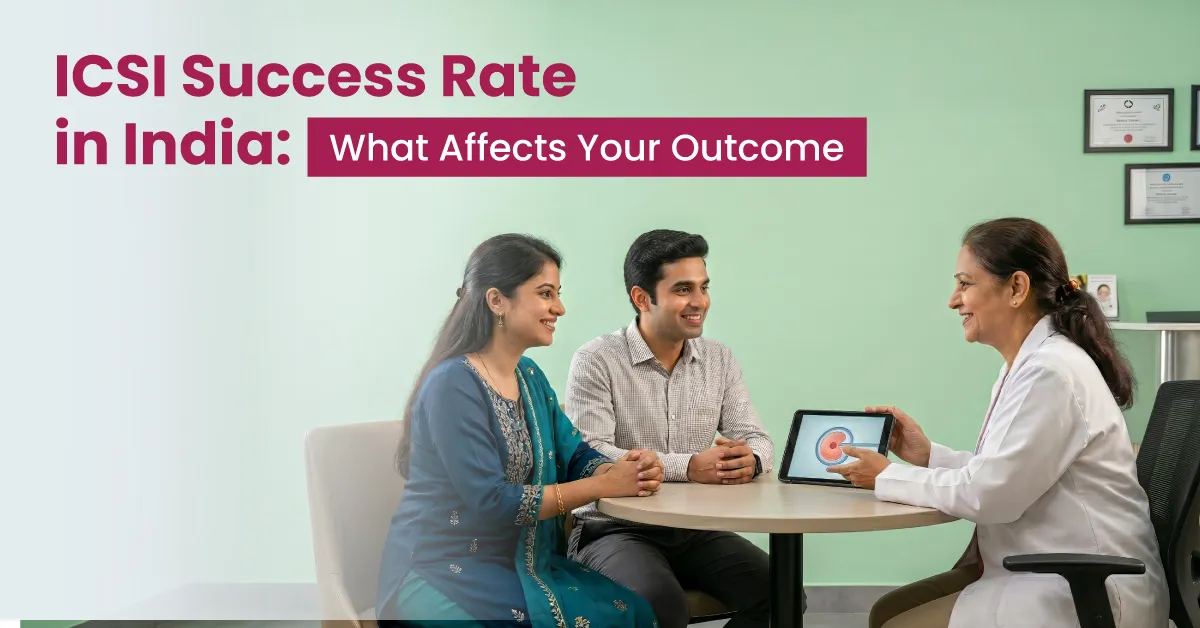
ICSI is commonly advised in IVF when fertilisation requires additional assistance, particularly in cases of male infertility. For many couples, questions around success rates, pregnancy chances, and whether ICSI will improve their odds come up immediately after hearing this recommendation.
One of the most common concerns is the ICSI success rate after embryo transfer, which is where the outcome of the entire cycle ultimately becomes measurable. Results can still differ based on several factors, including age, egg quality, sperm condition, and overall fertility status.
What Does ICSI Success Rate Actually Measure?
ICSI success rate after embryo transfer can be measured at different stages of the treatment cycle, which is why clinics may quote different percentages for the same procedure.
Fertilisation Rate
This refers to the number of injected eggs that successfully fertilise after ICSI. This is usually around 70 to 80%.
Clinical Pregnancy Rate
Means pregnancy has been confirmed on ultrasound after seeing a gestational sac or heartbeat.
Live Birth Rate
Refers to the number of treatment cycles that may ultimately result in a baby being born. This is usually the most meaningful success measure for couples because not every pregnancy leads to a live birth.
This is why asking clinics specifically about live birth rates often gives a more realistic understanding of treatment outcomes.
ICSI Success Rate by Age: What the Data Shows
Age plays a very important factor in ICSI success rate as it determines the egg quality and embryo development that widely vary with age, especially after age 35.
ICSI Success Rate Under 35: Highest Outcomes
Egg quality and ovary reserves in women under 35 are normally at their best. This results in very high success rates for ICSI in young women.
Fertilisation rates using the ICSI technique may be as high as 70-80%, while live birth rates are normally within 50-60% per cycle. In the case of male infertility, couples undergoing ICSI treatment will have the best chances for a successful pregnancy at this age.
ICSI Success Rate Between 35 and 40: Measurable Decline
The quality of eggs decreases and consequently reduces the ICSI success rate because egg quality reduces with increasing age from 35 to 40 years.
Live birth rates are expected to fall by 15-20% per cycle at ages above 40 years. It is common for most women to conceive through fertility treatments, but they are age-sensitive.
ICSI Success Rate After Embryo Transfer: The Implantation Phase
Once fertilisation is complete, the next step is the implantation of the embryo. For a successful implantation, the quality of the embryo, a healthy uterus and hormonal support play an important role.
Implantation occurs in about 20-40% of transfers. This number is usually higher when a Day 5 blastocyst is transferred, because the embryo is more developed by that point. Doctors generally look at sperm health and other fertility factors together before deciding if ICSI is the right option for a couple.
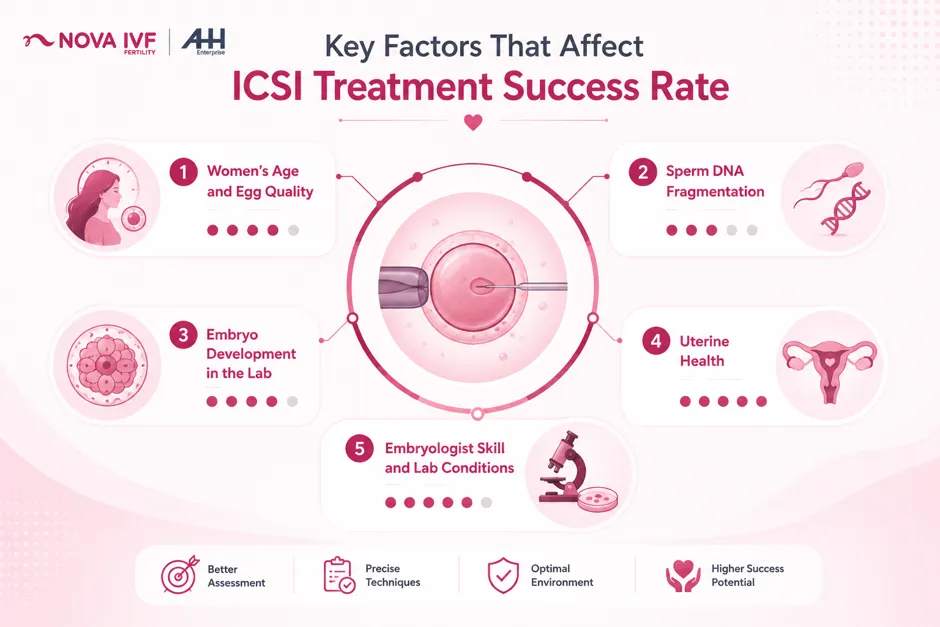
Key Factors That Affect ICSI Treatment Success Rate
Not every ICSI cycle ends the same way. These five factors have the strongest influence on the ICSI treatment success rate and whether the treatment actually works.
- Women's Age and Egg Quality – Women under 35 tend to have healthier eggs and a stronger ovarian reserve, which directly improve the development of embryos during treatment.
- Sperm DNA Fragmentation – High sperm DNA damage can stop a pregnancy from happening even if fertilisation occurs. Smoking, high BMI, and older male age are known to make this worse.
- Embryo Development in the Lab – Not every fertilised egg grows into a healthy embryo. Those who reach the blastocyst stage by Day 5 have a significantly higher chance of implantation.
- Uterine Health – Conditions like endometriosis, fibroids, or a thin uterine lining can prevent even a healthy embryo from attaching and growing.
- Embryologist Skill and Lab Conditions – Research confirms that small technical differences during the ICSI process, including how the needle is handled and how embryos are maintained, can directly affect fertilisation and survival rates.
How is ICSI Different From Standard IVF?
Dr. Pratibha Singh, a top Fertility Specialist at Varanasi, explains in her medical overview, ICSI (Intracytoplasmic Sperm Injection) is specifically advised when standard fertilization needs extra assistance.
The difference between IVF and ICSI is that, unlike standard IVF where eggs and sperm are left to fertilize on their own, ICSI allows the embryologist to select a single healthy sperm and inject it directly into the egg, making it essential for severe male factor infertility (low count, poor motility), surgically retrieved sperm, or previous failed IVF attempts.
If you're unsure whether IVF or ICSI is the right treatment for your fertility condition, consult a fertility specialist for an individualized assessment. At our Fertility Clinic in Varanasi, and all other Nova IVF fertility centres across the country, experienced fertility specialists and embryologists evaluate each case to recommend the most appropriate treatment approach.
FAQs
What is the average ICSI success rate in India?
ICSI success rates in India for women under 35 usually range between 45 and 60 per cent per cycle at experienced fertility centres.
Is ICSI more successful than IVF?
ICSI is not more successful than IVF; they both achieve the same results. ICSI is highly recommended for issues related to male infertility cases, whereas, for couples who don't have sperm-related issues, both treatments work the same.
How many ICSI cycles does it take to get pregnant?
Many couples conceive within one to three ICSI cycles, although outcomes depend on age, embryo quality, and overall fertility health.
Does sperm quality affect the ICSI success rate?
Yes, even with ICSI, sperm quality can directly affect the health of embryo development, chances of implantation and successful pregnancy.
Related Fertility Blogs