 Self-cycleTM IVF


-
-
-
 Infertility Counselling
-
 Female Infertility Treatment
-
 Andrology Treatment
-
 Fertility Enhancing Surgeries - Female
-
 Fertility Enhancing Surgeries - Male
-
 Endoscopy Treatment
-
 IUI Treatment
-
 IVF Treatment
-
 ICSI Treatment
-
 Advance IVF Solutions
-
 Embryology
-
 Vitrification Egg, Embryo, Sperm Freezing
-
 Preimplantation Genetic Testing (PGT)
-
 Donation Program Embryo / Egg / Sperm
-
 Self-cycleTM IVF
-
-
-
-
-
Anteverted Uterus Pregnancy Explained: Bump Changes, Best Positions, and What to Expect
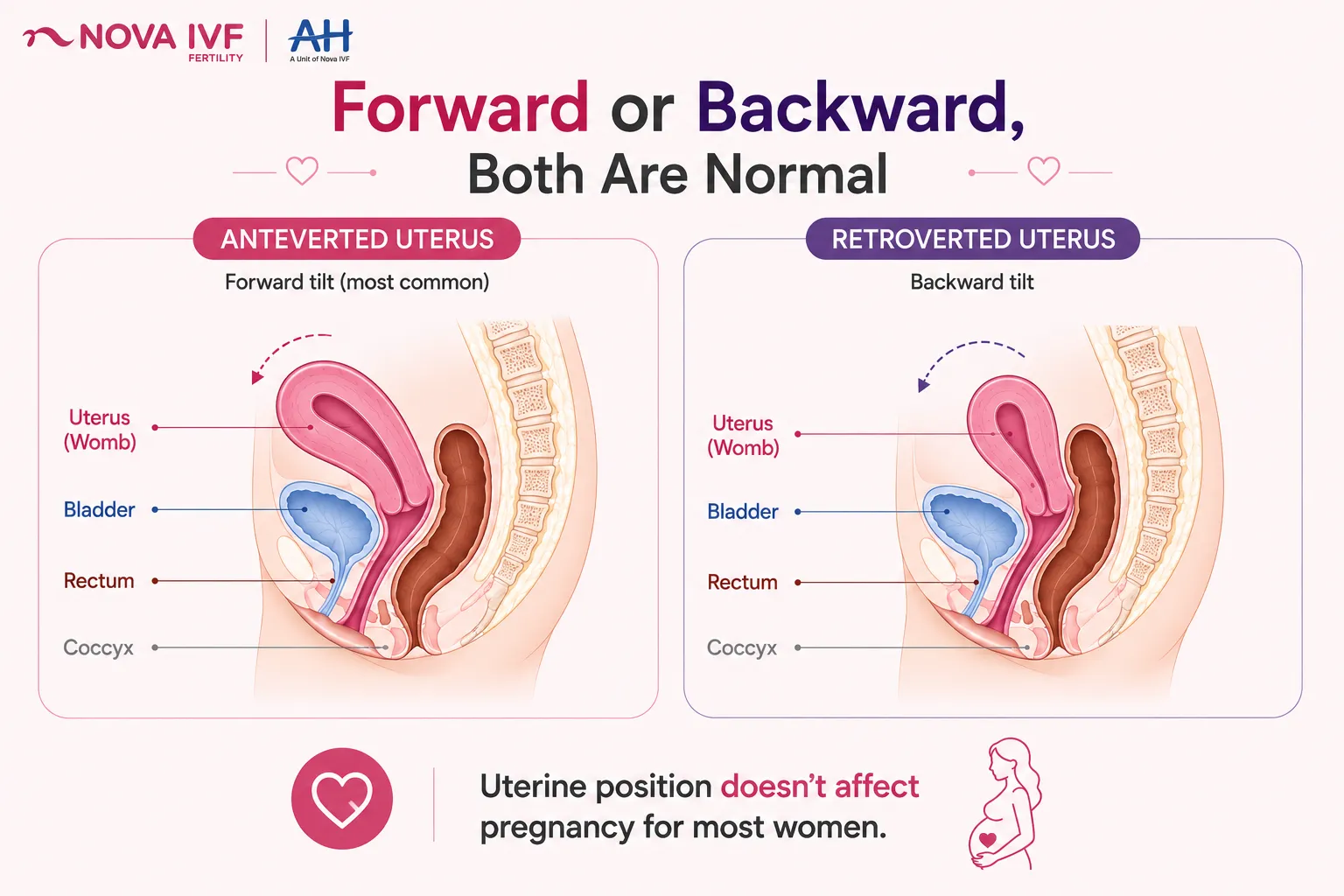
An anteverted uterus is the most common, normal position of the womb, tilted forward toward the bladder. In pregnancy, this forward tilt is a normal anatomical variant and is not treated as a risk factor. The main change you might notice is a slightly different bump shape.
Seeing an unfamiliar word like anteverted on a scan report often sparks worry. The forward tilt is simply an anatomical variation, read off a routine ultrasound observation rather than a diagnosis. It affects neither conception nor the baby's growth, and no treatment is aimed at the tilt itself.
What Is an Anteverted Uterus?
The uterus, or womb, is a pear-shaped organ in the pelvis, between the bladder and the back passage. An anteverted uterus tilts forward toward the bladder, which is the position most women have. A womb that tilts backward toward the spine is called retroverted, and it is equally normal.
Uterine position is simply read off a routine ultrasound, and it is not a disease. As per Orr N, et al, Sexual Medicine Reviews 2020, it was found that a retroverted uterus appears in roughly 15 to 20 percent of women, so the forward, anteverted tilt is the more common one. Neither tilt is something you can feel.
How Does an Anteverted Uterus Affect Pregnancy?
For most women, an anteverted uterus changes very little about pregnancy itself. The womb grows upward and outward as the baby develops, whatever tilt it started from. By around 12 weeks it rises out of the pelvis into the abdomen, so the starting tilt no longer sets its position.
Anteverted Uterus Pregnancy Bump: Will It Look Different?
Because the womb projects forward, an anteverted uterus pregnancy bump can look slightly more prominent or show a little earlier. This is a cosmetic difference, not a problem for the pregnancy. Bump size depends far more on body build and whether it is a first pregnancy.
Best Position for Pregnancy With an Anteverted Uterus
When couples ask about the best position for pregnancy with an anteverted uterus, no position is proven to raise the odds. What matters more is timing intercourse around ovulation. An ovulation calculator can help identify the fertile window each cycle.
A guide to fertile periods explains the physical signs that mark the fertile window each month. Timing around ovulation, not posture, is the practical lever before conception. Clearer, stretchy cervical mucus and a small rise in waking temperature help pinpoint the fertile days.
While sleeping in the later part of pregnancy, lying on the side, often the left, is the general advice for every mother. It eases pressure on the large vein that returns blood to the heart. This lifts venous return and cardiac output, which supports steady blood flow to the placenta and the baby.
Does an Anteverted Uterus Affect Fertility?
An anteverted uterus does not affect fertility on its own. The forward tilt does not block sperm from reaching the fallopian tubes, and it does not stop an embryo implanting. A normal anteverted finding therefore has no independent effect on conception.
A 2024 cohort study in the European Journal of Obstetrics and Gynecology and Reproductive Biology examined this question. Led by Bachar, it examined uterine position, conception mode, and perinatal outcomes in nulliparous patients. Nulliparous means a first pregnancy, so the findings may not extend to women who have given birth.
Direct outcome data specific to an anteverted uterus is limited, since most studies group all normal variants together. Research more often targets a retroverted or a fixed, disease-related tilt instead. A finding in one position cannot simply be transferred to another.
Fertility depends on several factors that have nothing to do with uterine position:
- Regular ovulation and a balanced set of reproductive hormones
- Open, healthy fallopian tubes that let egg and sperm meet
- Egg and sperm quality, both of which decline with age
- Conditions such as PCOS, fibroids, or endometriosis, where present
Because these factors, not the tilt, decide conception, a normal anteverted finding rarely changes the plan. This content is for information only and does not substitute medical advice. Individual situations should be discussed with a qualified reproductive medicine specialist.
This is why a female fertility assessment reviews the whole picture rather than the tilt alone, and why turning a normal scan finding into a worry helps nobody. For the wider basics, the guide to understanding fertility is a useful place to start. It explains what truly affects conception.
Symptoms to Watch: When to See a Specialist
An anteverted uterus produces no symptoms by itself, so the tilt needs no treatment. What deserves attention is any symptom that points to a separate condition, sometimes one that also pulls the womb into a fixed position. See a gynaecologist if you notice any of the following:
- Severe or persistent pelvic pain, beyond mild period cramps
- Heavy or irregular bleeding between periods
- Pain during deep intercourse
- No pregnancy after 12 months of trying, or after 6 months if you are over 35
An anteverted uterus produces no symptoms by itself, so the tilt needs no treatment. What deserves attention is any symptom pointing to a separate condition. Some of those conditions can also pull the womb into a fixed position.
See a gynaecologist if any of these appear, since each can signal a separate condition:
| Symptom to watch | Why it needs review |
|---|---|
| Severe or persistent pelvic pain | Points beyond normal period cramps |
| Heavy or irregular bleeding between periods | Warrants a check for an underlying cause |
| Pain during deep intercourse | Can point to endometriosis or fibroids |
| No pregnancy after 12 months, or 6 months if over 35 | Meets the threshold for a fertility assessment |
Frequently Asked Questions
Can an anteverted uterus affect getting pregnant?
No, an anteverted uterus is a normal forward tilt. It does not block sperm or prevent implantation. When conception is difficult, the cause usually lies in ovulation, the tubes, egg or sperm quality, or PCOS.
Does an anteverted uterus make your pregnancy bump show earlier?
It can happen in some pregnancies. Because the womb tilts forward, an anteverted uterus pregnancy bump may look slightly more prominent or appear a little earlier. This is a cosmetic difference, and body build and first pregnancies matter far more.
What is the best sleeping or sex position with an anteverted uterus?
No sexual position is proven to improve conception. Timing around ovulation matters more than posture. In later pregnancy, side-lying, often on the left, improves venous return, which supports blood flow to the womb.
Is an anteverted uterus normal?
An anteverted uterus is the most common uterine position. It sits tilted forward over the bladder and appears in roughly four out of five women. It produces no symptoms and needs no treatment on its own.
Related Fertility Blogs