 Self-cycleTM IVF


-
-
-
 Infertility Counselling
-
 Female Infertility Treatment
-
 Andrology Treatment
-
 Fertility Enhancing Surgeries - Female
-
 Fertility Enhancing Surgeries - Male
-
 Endoscopy Treatment
-
 IUI Treatment
-
 IVF Treatment
-
 ICSI Treatment
-
 Advance IVF Solutions
-
 Embryology
-
 Vitrification Egg, Embryo, Sperm Freezing
-
 Preimplantation Genetic Testing (PGT)
-
 Donation Program Embryo / Egg / Sperm
-
 Self-cycleTM IVF
-
-
-
-
-
Antral Follicle Count (AFC): What Is a Normal Range, What Low AFC Means and How It Affects IVF
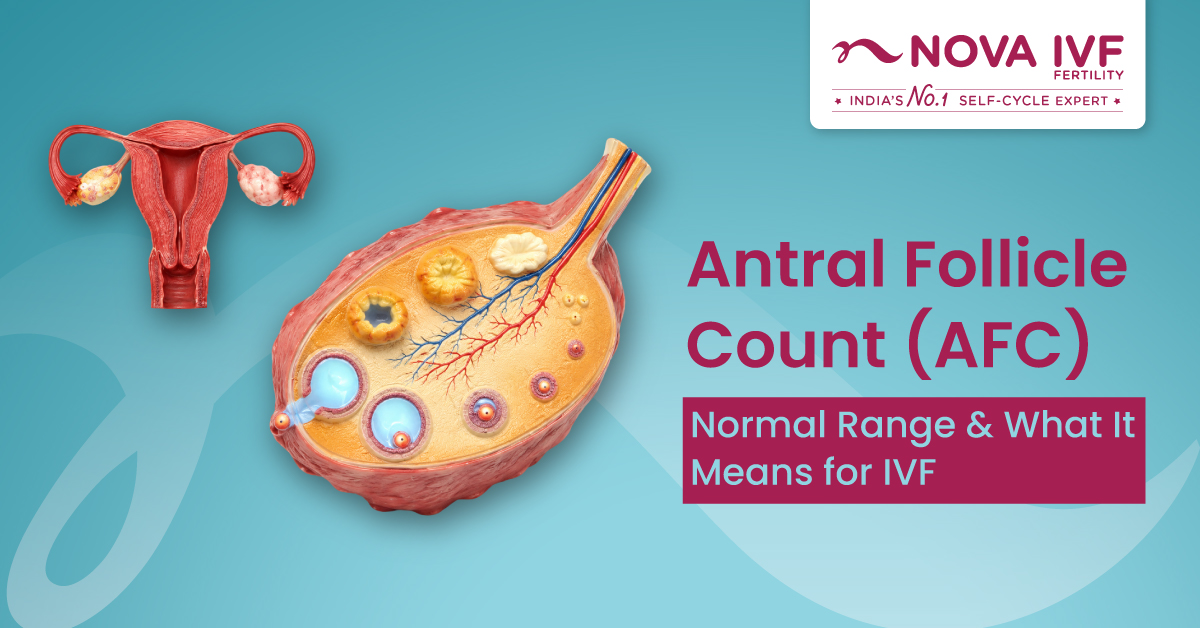
AFC is a largely discussed fertility metric among doctors and patients. A low count can feel like a disappointment. A high count can feel falsely reassuring. Neither interpretation is entirely accurate.
What Is Antral Follicle Count and What Does It Measure
Antral follicles are small, fluid-filled sacs visible on ultrasound (each measuring roughly 2 to 9mm in diameter) that sit in a resting state inside your ovaries. Each sac holds an immature egg.
The antral follicle count (AFC) is simply a count of how many of these resting follicles are visible across both ovaries at the start of your menstrual cycle.
How Is the AFC Test Done in India
The AFC count test is performed via transvaginal ultrasound, ideally on Day 2, 3, or 4 of your menstrual cycle.
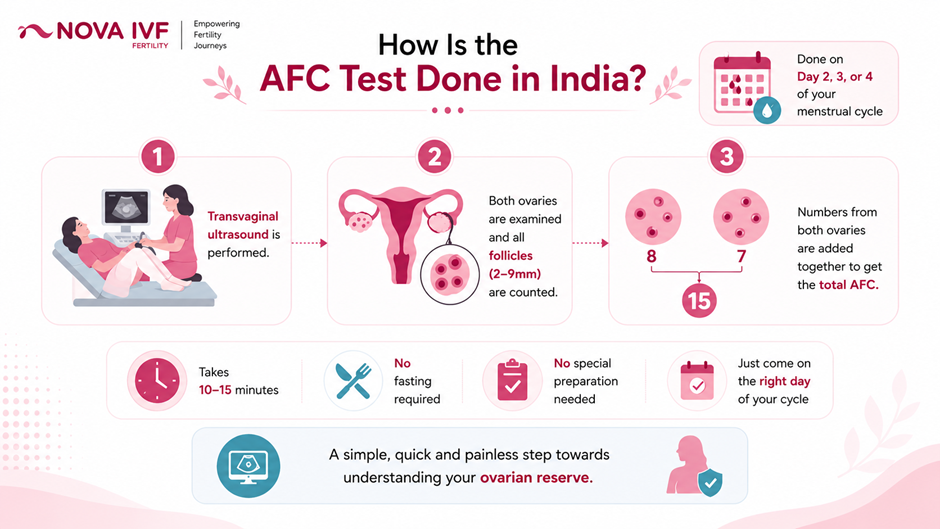
During the scan, a trained sonographer examines both ovaries and counts all visible follicles within the 2–9mm range. The numbers from each ovary are added together to give a total AFC.
Normal Antral Follicle Count by Age: What the Numbers Mean
AFC naturally declines with age. Below is a general reference table used by fertility specialists in India:
| Age Group | Normal AFC Range | What It Suggests |
|---|---|---|
| Under 30 | 15–30 | Strong ovarian reserve; good response to stimulation expected |
| 30–34 | 12–20 | Good reserve; IVF outcomes remain favourable in most cases |
| 35–37 | 8–15 | Moderate reserve; protocol planning becomes more individualized |
| 38–40 | 5–10 | Declining reserve; closer monitoring and adjusted dosing recommended |
| Above 40 | Below 5–8 | Low reserve likely; mini-IVF or donor egg options may be discussed |
These are reference ranges, not fixed rules. If your count is on the lower side, egg freezing for low AFC patients at Nova IVF may be worth discussing
What Does a Low Antral Follicle Count Mean for IVF
A low AFC (below 5–7) will affect IVF in specific ways:
- Lower Stimulation Response: Fewer follicles means fewer eggs retrieved. Often 1–3 versus 8–15 in women with normal AFC.
- Higher Cycle Cancellation Risk: If follicles don't develop adequately during stimulation, the cycle may be stopped before egg retrieval.
- Less Embryos Available: If Less eggs are retrieved, it means that fewer embryos for transfer or freezing, affecting cumulative success rates over multiple attempts.
- IVF Can Still Work: Even with lower count, many women still decide to conceive through IVF.
Dr. Nidhi, an IVF specialist in Patna, clarifies that a lower follicle count does not reduce your chances of achieving a pregnancy. It only tells the clinical team how many eggs to work with during retrieval.
Patients visiting our IVF clinic in Patna can expect their AFC result to be reviewed alongside AMH, FSH, and age before any protocol decisions are made, ensuring the stimulation plan reflects the full ovarian picture rather than a single number
Explore our female infertility evaluation
How Nova IVF Uses AFC to Plan Your IVF Protocol
Once the AFC number is determined, you need to decipher what comes next. This means knowing how that number shapes your treatment plan.
At Nova IVF, the antral follicle count ultrasound result is never read alone. It is combined with:
- AMH (anti-Müllerian hormone),
- Day-3 FSH,
- Rstradiol levels, and your
- Age to build a stimulation protocol before your first IVF cycle begins.
Here's how that plays out in practice:
- High AFC (above 15–20): Lower stimulation doses are used to reduce the risk of OHSS.
- Low AFC (below 7): Higher doses and a more closely monitored stimulation window are used to maximise the number of follicles that respond. Monitoring scans are more frequent.
- AFC also informs the type of IVF: Whether conventional IVF, mini-IVF (lower stimulation, fewer eggs), or donor egg IVF is the most appropriate recommendation, is partly driven by AFC alongside other reserve markers. You can Learn more about IVF stimulation and follicle monitoring at Nova IVF.
Nova IVF fertility specialists interpret your AFC within your complete ovarian reserve picture. That's not just better medicine. It's a fundamentally different approach to planning treatment.
Explore our fertility test package
FAQs
What is a good antral follicle count for IVF?
An AFC between 10 and 20 is considered optimal. It signals a good ovarian response without over-stimulation risk.
Can antral follicle count improve naturally?
AFC fluctuates slightly between cycles but does not meaningfully increase over time. No supplement or lifestyle change has been proven to raise it.
Is a high AFC always a good sign?
An AFC above 25 raises OHSS risk, where ovaries over-respond to stimulation. Especially relevant for Indian women with PCOS, where high counts are normal. High AFC needs careful dose calibration, not aggressive stimulation.
How is AFC different from AMH in measuring ovarian reserve?
AFC is a direct ultrasound count of visible follicles right now. AMH is a blood test reflecting overall reserve more consistently across the cycle.