 Self-cycleTM IVF


-
-
-
 Infertility Counselling
-
 Female Infertility Treatment
-
 Andrology Treatment
-
 Fertility Enhancing Surgeries - Female
-
 Fertility Enhancing Surgeries - Male
-
 Endoscopy Treatment
-
 IUI Treatment
-
 IVF Treatment
-
 ICSI Treatment
-
 Advance IVF Solutions
-
 Embryology
-
 Vitrification Egg, Embryo, Sperm Freezing
-
 Preimplantation Genetic Testing (PGT)
-
 Donation Program Embryo / Egg / Sperm
-
 Self-cycleTM IVF
-
-
-
-
-
Dyspareunia: Causes, Symptoms and How to Cure Painful Intercourse
Dyspareunia: Causes, Symptoms and How to Cure Painful Intercourse
If you have ever experienced pain during intimacy, you know how isolating and distressing it can feel. Many women quietly push through the discomfort, believing it is something they just have to live with or feeling too embarrassed to bring it up with a doctor. Please know that you are not alone, and it is not your fault.
Painful intercourse in women is a recognised medical condition called “Dyspareunia” that is surprisingly common. While it should never be considered "normal," it is treatable once the root cause is identified.
This guide breaks down what dyspareunia is, what causes it, its common symptoms, and how medical care can help you regain comfort, confidence, and peace of mind.
What Does Dyspareunia Mean?
Dyspareunia describes genital pain that is persistent or recurrent and tied to intercourse. The pain can be sharp, burning, aching, or deep, and is far more common in women than men. Occasional discomfort is not the same thing; dyspareunia is a repeating pattern that interferes with intimacy.
Estimates depend on how the question is asked. The American College of Obstetricians and Gynecologists reports that nearly 3 out of 4 women have pain during intercourse at some point. That figure covers occasional pain, not a lasting problem.
As an ongoing condition, dyspareunia is less common. A 2021 review in American Family Physician put its prevalence at roughly 10 to 20% of women. The prevalence of dyspareunia in India is around 12.6%.
Medical professionals classify dyspareunia in two primary ways:
By Onset: Primary vs. Secondary
Primary Dyspareunia: Pain that has been present from the very first experience of sexual intercourse or penetration.
Secondary Dyspareunia: Pain that develops later in life after a period of comfortable, pain-free intercourse. This often follows significant physical changes such as childbirth, pelvic surgery, infection, or the hormonal shifts of perimenopause and menopause.
By Location: Superficial vs. Deep
Superficial (Entry) Dyspareunia: Discomfort felt at the vaginal opening or vulvar area right as penetration begins.
Deep Dyspareunia: Pain felt deep inside the pelvis or lower abdomen during deeper thrusting.
Dyspareunia Symptoms Every Woman Should Know
Dyspareunia symptoms vary with the cause, but most women recognise one or more familiar patterns. Noticing when and where the discomfort starts helps a doctor work out why. The most common signs appear below.
- Entry can bring a sharp or burning sensation at the vaginal opening.
- Deeper penetration can trigger a pelvic ache resembling menstrual cramps.
- Soreness after sex may last minutes to hours before easing.
- Muscles around the vaginal opening can tense involuntarily, making penetration feel tighter.
- Dryness around the vulva can cause a raw, chafed sensation and friction.
- Sex can start to feel like something to avoid once the body learns to expect pain.
One pattern deserves a separate mention. When the main problem is involuntary muscle tightening that blocks penetration, the cause may be vaginismus. The symptoms of vaginismus overlap with dyspareunia, so a careful assessment matters before assuming either.
Dyspareunia Causes: Why Painful Intercourse Happens
The causes of painful intercourse fall into two broad groups, physical and emotional, and both are often present together. Diagnosing causes of pelvic pain accurately usually needs a clinical assessment rather than guesswork. Several of these causes, including endometriosis and hormonal dryness, are also linked with difficulty conceiving.
Physical Causes of Dyspareunia
Most cases of painful intercourse have a physical driver. The common ones range from surface tissue problems to deeper pelvic disease. The location of the pain indicates the underlying cause.
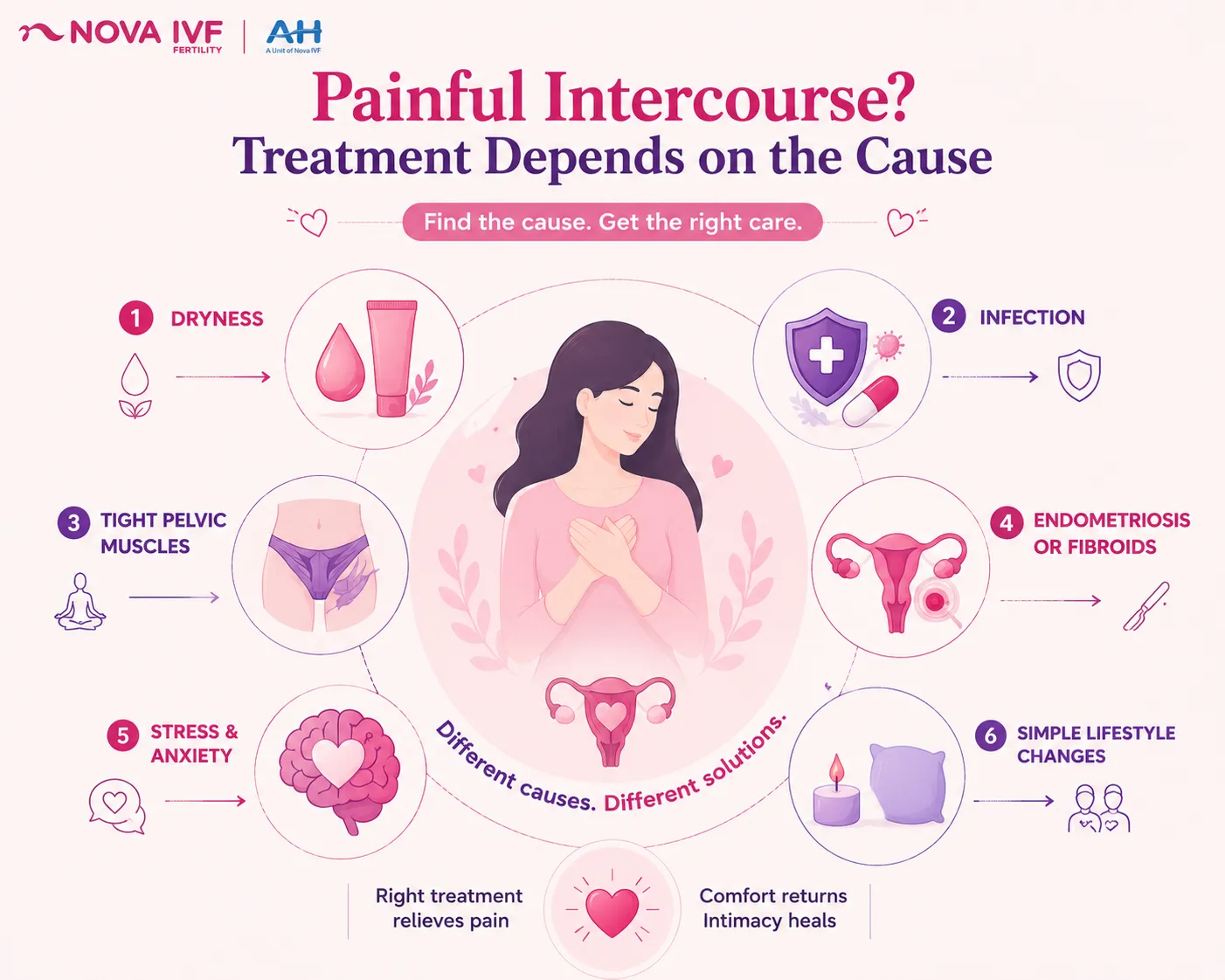
Pain during entry into the vagina may be due to vulvar or vaginal dryness due to hormonal changes, infection or injury.
Positional pain may be due to involvement of the pelvic floor muscles, vaginal dryness or infection.
Deep pain may be due to involvement of the bladder (such as urinary tract infection, cystitis), bowel (such as irritable bowel syndrome, ulcerative colitis or Crohn’s Disease), pelvic floor involvement or presence of endometriosis or fibroids.
The common reasons behind dyspareunia are:
- Vaginal dryness and low estrogen: during menopause, breastfeeding, or perimenopause are associated with thinner and drier tissue which raises friction and entry pain.
- Infections: yeast infections, urinary tract infections, and sexually transmitted infections cause inflammation of the sensitive tissue.
- Skin conditions: dermatitis, eczema, or lichen sclerosus of the vulva can make contact painful.
- Pelvic floor dysfunction: chronically tight or overactive pelvic muscles that resist penetration.
- Childbirth and scarring: healing after a delivery, tear, or episiotomy can make penetration sore for months.
- Endometriosis and fibroids: deeper pelvic conditions that typically cause pain on deep penetration.
A 2021 review in the International Journal of Gynecology and Obstetrics found that about a third of women report dyspareunia in the months after childbirth. This may be due to incomplete tissue healing after tissue injury at childbirth.
Endometriosis deserves close attention as well. It is a leading cause of deep dyspareunia, and the pain can appear years before diagnosis. Recognising endometriosis symptoms and signs early can spare years of unexplained pain.
Emotional and Psychological Causes
Pain during sex can be not only due to physical factors or medical conditions, but due to psychological reasons as well. Stress, anxiety, depression, relationship strain, fear of pain, or past trauma can all contribute. These states can tighten the pelvic floor, reduce arousal and natural lubrication, and lower the pain threshold.
A self-reinforcing cycle often forms. Pain creates the expectation of pain, which raises muscle tension and dryness, which makes the next attempt worse. Breaking that loop usually needs both physical treatment and psychological support.
It is important to note that the pain is not imagined. Emotional and physical causes are genuinely intertwined, and a psychological driver does not make the pain less real. Effective treatment involves addressing not only the physical and medical reasons but managing the psychological part as well.
How to Cure Dyspareunia: Treatment Options
Because dyspareunia has many possible causes, treatment depends on what drives the pain. The first step is always diagnosis, since the same symptom can arise from very different sources. Once the cause is clear, most women can be offered treatment that reduces or relieves the pain.
Some discomfort eases with simple changes before any prescription. Extending foreplay to build lubrication, using a good lubricant, and adjusting position to control depth can all help. These measures work best for dryness and tension-related pain, and do not replace treating the cause.
- For dryness, a lubricant during sex helps. Topical estrogen can relieve pain where estrogen is low, but it is to be used only under medical guidance. Vaginal dryness treatment often eases friction-related pain.
- For an infection, an antifungal or antibiotic course from a doctor treats the cause, and pain usually settles soon after.
- For pelvic floor tension, a pelvic health physiotherapist helps the muscles gradually relax.
- For a skin condition or structural problem, a topical treatment often helps, though some cases need a minor procedure.
- For emotional factors, counselling or sex therapy alongside physical treatment is associated with the most lasting relief.
The treatment also proves to be beneficial for couples trying to conceive. When having intercourse becomes comfortable again, then planning sex during the fertile window eventually seems like an easier decision. That removes a real but rarely discussed barrier to natural conception.
When to See a Doctor for Painful Intercourse
Occasional discomfort that settles on its own is usually nothing to act on. Persistent pain after sex is different, and it deserves assessment rather than patience. Visit a gynaecologist if you notice:
- Pain during or after sex that keeps returning across multiple episodes, since a repeating pattern usually points to a specific cause that will not clear on its own.
- Bleeding after sex, fever, or an unusual discharge appearing around the same time as the pain, all of which indicates an infection or another condition that gets harder to treat the longer it goes unchecked.
- Discomfort that begins to interfere with daily life, intimacy in the relationship, or plans to start a family, since the wider effect on wellbeing and on fertility is often greater than the pain itself.
- No real improvement despite lubricants, longer foreplay, or other simple changes at home.
A first appointment usually involves a conversation about when and where the pain occurs, a gentle pelvic examination, and sometimes a swab or ultrasound scan to check for infection or a structural cause. Saying the problem out loud is often the hardest and most important step.
This is general education, not a diagnosis for any individual. For a woman, painful intercourse that interferes with trying to conceive is worth raising early, because the assessment that explains the pain often forms part of a female fertility evaluation. To understand your symptoms and options, book a consultation with a Nova IVF gynaecologist.
Frequently Asked Questions
Is dyspareunia common in women trying to conceive?
Yes. Conditions that cause painful intercourse, such as endometriosis, dryness, or pelvic floor tension, can also affect fertility, so it is worth assessing early rather than pushing through the discomfort.
Can dyspareunia be treated?
Almost always. Once the underlying cause is identified, targeted options like lubricants, hormone therapy, infection treatment, pelvic floor physiotherapy, or counselling resolve or greatly reduce the pain for most women.
Does dyspareunia mean something is seriously wrong?
Not usually. Most causes are minor and easily treated. However, there are a few instances, like endometriosis or infection, which need proper care. It is recommended that persistent pain should always be evaluated rather than ignored.
Can stress alone cause painful intercourse?
Yes. Feeling stressed or anxious can make the pelvic muscles tense up and reduce natural lubrication, and both of those can lead to pain during sex even when nothing is physically wrong.