 Self-cycleTM IVF


-
-
-
 Infertility Counselling
-
 Female Infertility Treatment
-
 Andrology Treatment
-
 Fertility Enhancing Surgeries - Female
-
 Fertility Enhancing Surgeries - Male
-
 Endoscopy Treatment
-
 IUI Treatment
-
 IVF Treatment
-
 ICSI Treatment
-
 Advance IVF Solutions
-
 Embryology
-
 Vitrification Egg, Embryo, Sperm Freezing
-
 Preimplantation Genetic Testing (PGT)
-
 Donation Program Embryo / Egg / Sperm
-
 Self-cycleTM IVF
-
-
-
-
-
Frozen Embryo Transfer: How the Process Works, When It Happens and What to Expect
Frozen Embryo Transfer: How the Process Works, When It Happens and What to Expect
Did you know that over 60% of embryo transfers in India are now frozen transfers? There is a reason that number keeps climbing.
Frozen embryo transfer gives the body time to recover, creates better conditions for implantation, and the success rates show it. But most patients still have no clear picture of what actually happens between egg retrieval and transfer day.
This guide covers the entire frozen egg transfer process, step by step, so you know exactly what to expect and when.
What Is a Frozen Embryo and How Is It Preserved?
Embryos that are not used in the current cycle are frozen through a process called vitrification. The embryo is rapidly dehydrated and frozen at ultra-low temperatures. The speed is what matters here.
Older methods froze embryos slowly, and that gave ice crystals time to form inside the cells, causing damage. Vitrification happens too fast for that. A frozen embryo stored this way can stay viable for months or years, and the quality holds up. Couples can plan the transfer around their own timeline without worrying about what waiting does to the embryo.
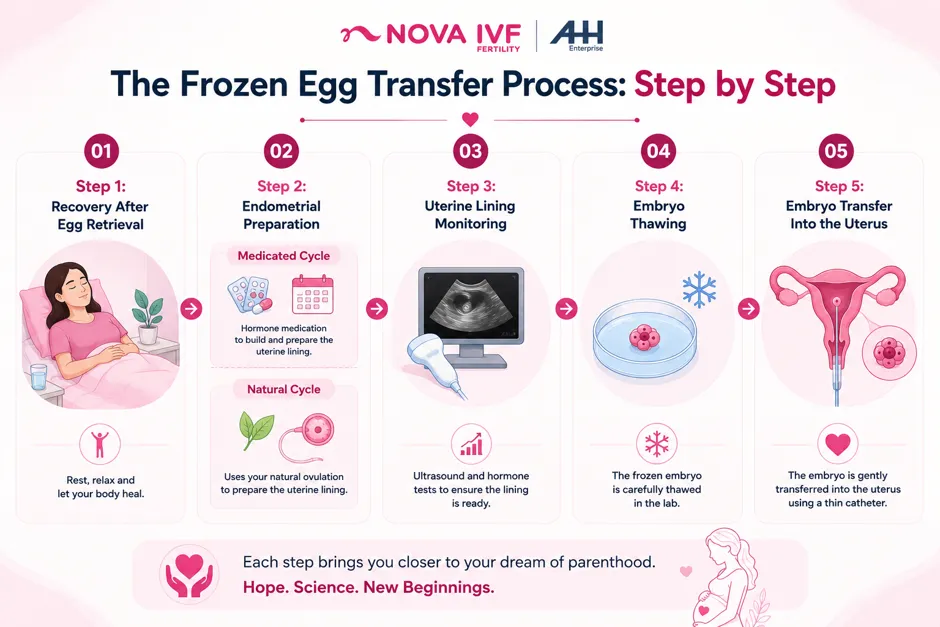
The Frozen Egg Transfer Process: Step by Step
The FET cycle follows a set sequence, with each stage building toward the transfer itself.
Step 1: Recovery After Egg Retrieval
The body needs at least one full cycle to recover after egg retrieval before the frozen embryo transfer can begin. Stimulation medications affect the uterine lining, and it takes time for it to return to its natural state. Most specialists recommend waiting 4 to 8 weeks.
This is not extra waiting for no reason. The body simply performs better in a transfer cycle after that reset.
Step 2: Endometrial Preparation
Getting the uterine lining ready is the most important step in any FET cycle. How that happens depends on whether the patient ovulates regularly.
Medicated Cycle
Estrogen and progesterone are given in sequence to build the lining to the right thickness and pattern. This is the standard approach when ovulation is irregular, absent, or when the doctor needs precise control over transfer timing.
Natural Cycle
Ovulation is tracked, and the transfer is timed around the body's own implantation window. No hormones are used to develop the lining. This works well for patients who ovulate regularly and consistently.
Step 3: Uterine Lining Monitoring
Before the transfer can go ahead, the uterine lining needs to be checked. Doctors use ultrasound scans to confirm thickness and pattern.
If the lining is not where it needs to be, the cycle gets adjusted or pushed back. It is a simple check but an important one.
Similar hormone preparation and monitoring are also part of understanding the preserving process.
Step 4: Embryo Thawing
On transfer day, the frozen embryo is thawed in the lab. Vitrification means over 95% of embryos come through the thaw intact.
Blastocyst-stage embryos get back to normal cellular activity quickly once they warm to body temperature. The embryologist checks the embryo and gives the go-ahead before anything moves to the transfer room.
Step 5: Embryo Transfer Into the Uterus
The thawed embryo is loaded into a thin catheter and guided into the uterus using ultrasound. The whole thing takes 10 to 15 minutes. No anaesthesia is needed.
After the transfer, progesterone support continues to keep the lining stable. A beta-hCG blood test 12 to 14 days later confirms whether the pregnancy has taken place.
After Egg Retrieval, When Is Frozen Embryo Transfer Done?
The frozen embryo transfer is typically performed 4 to 8 weeks after egg retrieval, allowing one full menstrual cycle for recovery, endometrial normalisation, and protocol preparation.
If PGT-A genetic testing has been requested, the wait may extend to 6 to 10 weeks to allow for biopsy and results. Couples can also choose to delay FET by months or years, as frozen embryos remain viable indefinitely with vitrification.
Why FET Is Now the Preferred Choice in IVF Cycles
Three clinical reasons explain why frozen transfer has become the dominant approach:
- A non-stimulated uterus is more receptive to implantation than one still under hormonal stimulation, which can cause endometrial asynchrony
- FET eliminates OHSS risk entirely, which is particularly relevant for women with PCOS, a condition highly prevalent in the Indian patient population
- Vitrification allows PGT-A genetic screening before transfer, reducing miscarriage risk and improving live birth rates across age groups
FAQs
How long does a frozen embryo transfer cycle take?
The preparation phase typically spans 3 to 4 weeks. The full timeline from retrieval to FET is usually 4 to 8 weeks, including recovery after egg retrieval.
Is the frozen embryo transfer procedure painful?
No. Patients usually experience slight pressure during the process, just like they do during a Pap smear. It lasts 10-15 minutes and needs no anaesthetic.
What is the success rate of frozen embryo transfer in India?
In India, the success rate of FET procedures usually lies between 40% and 60% depending on the age, quality of embryo, and uterus condition at the time of embryo transfer.
How long can frozen embryos be stored before transfer?
Embryos can be frozen and stored for a maximum of ten years in India, according to the ICMR. The quality of the embryos remains intact due to vitrification.