 Self-cycleTM IVF


-
-
-
 Infertility Counselling
-
 Female Infertility Treatment
-
 Andrology Treatment
-
 Fertility Enhancing Surgeries - Female
-
 Fertility Enhancing Surgeries - Male
-
 Endoscopy Treatment
-
 IUI Treatment
-
 IVF Treatment
-
 ICSI Treatment
-
 Advance IVF Solutions
-
 Embryology
-
 Vitrification Egg, Embryo, Sperm Freezing
-
 Preimplantation Genetic Testing (PGT)
-
 Donation Program Embryo / Egg / Sperm
-
 Self-cycleTM IVF
-
-
-
-
-
High AMH Levels: What It Means for Your Fertility and How to Treat It
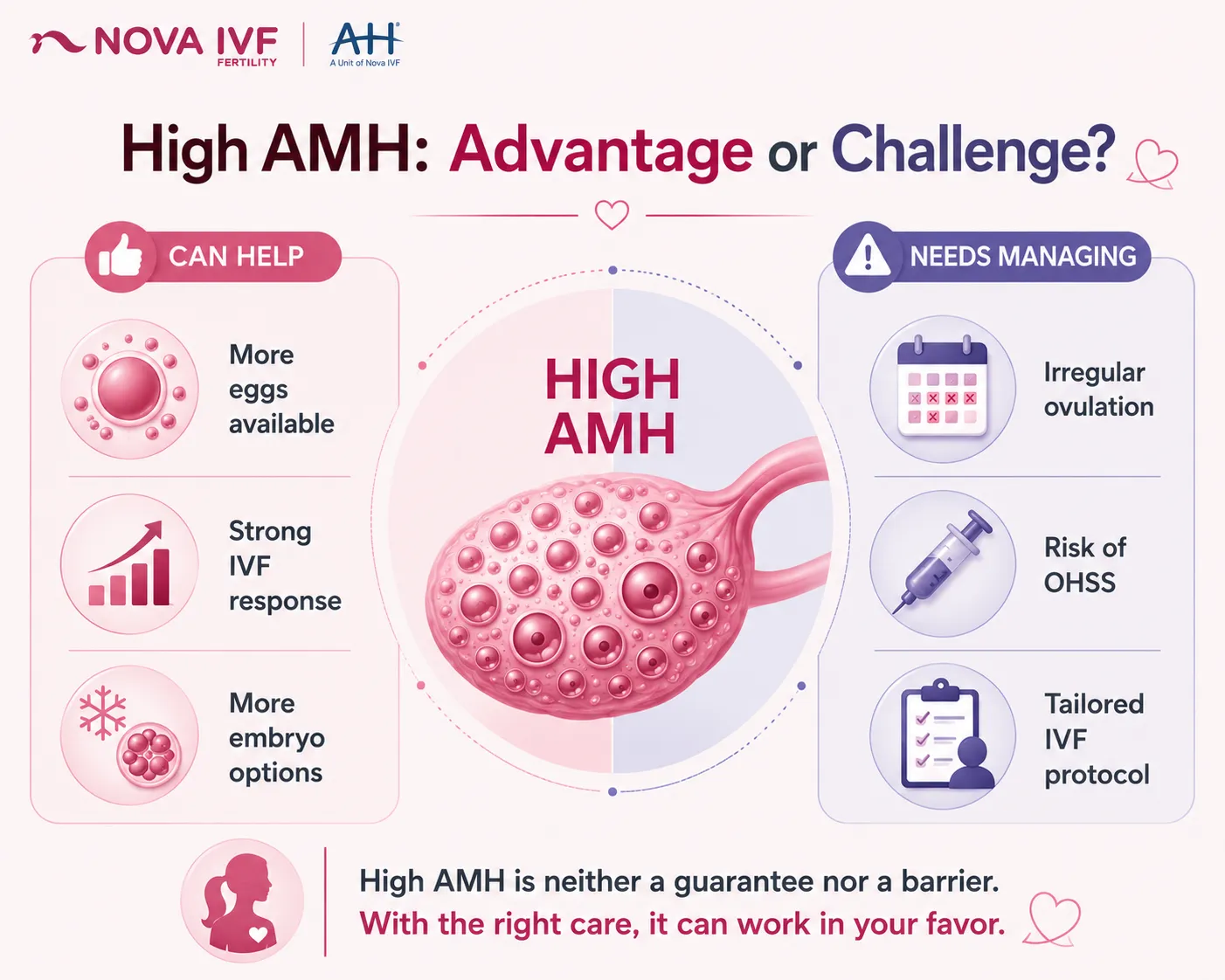
Anti-Mullerian hormone, or AMH, is a hormone your ovaries make that reflects how many eggs you have in reserve. A high AMH level usually means a large pool of small follicles, most often linked to polycystic ovary syndrome, or PCOS. On its own, it is not a disease.
Receiving a high result can feel confusing, since low AMH is found to be discussed far more often. A high result does not lower your egg quality or signal early menopause. Its meaning depends on your age and cycle. A high AMH is best read alongside your ultrasound and ovulation pattern.
What Does a High AMH Level Mean?
A high AMH level points to a high ovarian reserve, a larger than average pool of eggs for your age. It most often reflects PCOS, where many small follicles each add to the total. The number tracks egg quantity, not egg quality.
AMH is made by granulosa cells, which line each small growing follicle. The more small follicles present, the more AMH passes into the blood, where an AMH test measures it. This makes AMH a practical marker of ovarian reserve, the eggs still held in the ovaries.
Sengupta and colleagues studied age-specific AMH in Indian women. Their 2023 paper in the International Journal of Reproduction, Contraception, Obstetrics and Gynecology reported reference values that decline steadily with age. A high reading is therefore judged against your age band.
Normal AMH Levels by Age: What Counts as High?
AMH levels are generally highest in the mid-20s and fall with age. Because a younger woman's normal range sits higher, the threshold for high rises with each age band.
| Age band | Typical AMH (ng/mL) | Often flagged as high |
|---|---|---|
| Under 25 | about 3.0 to 5.0 | above roughly 5 to 6 |
| 25 to 30 | about 2.5 to 4.0 | above roughly 5 |
| 30 to 35 | about 1.5 to 3.0 | above roughly 4 |
| 35 to 40 | about 1.0 to 2.0 | above roughly 3 |
| Over 40 | about 0.5 to 1.5 | above roughly 2.5 |
Because labs use different test kits, read your report against that lab's own reference range, not a generic chart. In PCOS, AMH typically runs well above the age-matched reference range. Sengupta and colleagues set a PCOS cut-off near 7.5 ng/mL in Indian women in their 2023 study.
Reviewing AMH levels by age with a specialist gives a clearer picture than any chart alone. The specialist weighs the number against your ultrasound and reported symptoms. Symptoms such as irregular periods can point to PCOS even when the AMH is only mildly raised.
Common Causes of High AMH Levels
High AMH usually traces to one of a few causes, and most are harmless. The most common is simply a large number of small follicles. A rare tumour is the one cause a specialist takes care to exclude.
- PCOS is the most frequent cause, since the many small follicles in polycystic ovaries each produce AMH and raise the total.
- Younger age naturally brings higher AMH, because the egg reserve is larger earlier in reproductive life.
- A naturally high egg reserve means some women simply have more follicles, with no underlying condition.
- Granulosa cell tumours, a rare ovarian tumour type, can raise AMH and are an uncommon but important cause to exclude.
For most women, a high AMH reflects PCOS or a naturally generous reserve, not a tumour. The link between PCOS and fertility is well studied, and a specialist reads the number alongside age and ultrasound. Tumour-related rises are rare and usually flagged by other ovarian findings.
Symptoms of High AMH Levels
AMH levels itself cause no symptoms, and a high level is found through a blood test. When symptoms do appear, they come from the underlying cause, most often PCOS, where PCOS and infertility can be linked. The signs to watch are the signs of PCOS.
- Irregular or infrequent periods are the most common sign of the PCOS behind many high AMH results.
- Acne, oily skin, or extra facial and body hair can reflect the hormone pattern of PCOS.
- Difficulty losing weight and unpredictable ovulation often go with the same condition.
- Many women have no symptoms at all, and the high AMH shows up only during fertility testing.
High AMH and PCOS: What's the Connection?
In PCOS, the ovaries hold many small antral follicles, the fluid-filled sacs that each contain an immature egg. Each follicle releases AMH, so together they push the total well above the usual range. This is why AMH now helps identify polycystic ovarian morphology in adults.
The 2023 International Evidence-based Guideline for PCOS accepts serum AMH as an alternative to ultrasound for assessing polycystic ovarian morphology. That morphology is only one of three diagnostic criteria, not PCOS on its own. A specialist confirms PCOS when the full criteria are met.
The same large follicle pool means the ovaries can over-respond to fertility medication. Pushed too far, this can lead to ovarian hyperstimulation syndrome, or OHSS, where the ovaries swell and fluid shifts into the abdomen. Managing this risk is closely tied to the ovulation disorders seen in PCOS.
High AMH and Pregnancy: Does It Help or Hurt Your Chances?
High AMH levels do not prevent pregnancy, and on their own they often reflect a plentiful egg supply rather than a problem. What matters more for conception is whether ovulation is regular. When PCOS disrupts ovulation, restoring a regular cycle is the step that most helps conception.
| Where high AMH can help | What needs managing |
|---|---|
| A larger egg reserve can mean more eggs retrieved during IVF | Irregular ovulation from PCOS can delay natural conception |
| A strong response to stimulation in well-planned cycles | A higher risk of ovarian hyperstimulation during IVF |
| More flexibility in choosing a protocol | The need for tailored, lower-dose stimulation |
Regular ovulation, healthy fallopian tubes, and a partner's sperm quality all shape the real chance of pregnancy. A high AMH count does not offset problems in any of these areas. A female fertility assessment places the AMH result in context with age and ovulation.
Treatment for High AMH Levels
Treatment targets the cause of high AMH, not the number itself. There is no clinical benefit in lowering AMH for its own sake. The right approach depends on whether PCOS is present and whether you are trying to conceive.
If high AMH comes from PCOS
- Weight management and a low-glycaemic diet, one that avoids sharp blood-sugar spikes, can improve ovulation.
- Metformin, a medicine that helps the body handle insulin, may be used to address the insulin resistance common in PCOS.
- When conception is the goal, a tablet such as letrozole can prompt the ovaries to release an egg and restore a regular cycle.
The 2023 International Evidence-based Guideline for PCOS places lifestyle measures first, adding medication only when they are not enough. Broader evidence on lifestyle and infertility points the same way. These steps act on the root condition, while AMH itself may change only slightly.
If you are undergoing IVF
- A GnRH antagonist protocol, a medication schedule that prevents premature ovulation, suits high responders and lowers the risk of hyperstimulation.
- Gonadotropin doses, the injectable hormones that grow eggs, are matched to the AMH level to avoid over-stimulation.
- A GnRH agonist trigger with a freeze-all approach, where embryos are frozen for a later transfer, can lower hyperstimulation risk further.
For high responders, including many women with PCOS, an antagonist protocol is generally preferred to lower OHSS risk. The ASRM 2023 guideline on ovarian hyperstimulation syndrome sets out these risk-reducing steps. The aim is a safe, controlled response rather than the largest possible egg count.
Frequently Asked Questions
What is a high AMH level for my age?
A High AMH level is judged relative to your age, since it falls over time. A level above roughly 4 to 5 ng/mL in your late 20s or early 30s is often flagged, though labs and reference ranges vary.
Can high AMH levels prevent pregnancy?
No, a high AMH does not prevent pregnancy and often reflects a healthy egg reserve. The fertility challenge, when there is one, usually comes from the irregular ovulation of PCOS rather than the AMH itself. Restoring regular ovulation is usually the key step toward conception.
Can AMH levels be reduced naturally?
AMH reflects your follicle pool, so it cannot be deliberately lowered to a target. Lifestyle steps for PCOS, such as weight management and a low-sugar diet, can modestly improve the hormone picture. The goal is healthier ovulation, not a lower number.
Is high AMH good for IVF?
It can be an advantage, since a larger reserve often means more eggs are collected. The trade-off is a higher risk of ovarian hyperstimulation, which specialists manage with adjusted protocols. High AMH is one favourable factor, not a guarantee of success.
Related Fertility Blogs