 Self-cycleTM IVF


-
-
-
 Infertility Counselling
-
 Female Infertility Treatment
-
 Andrology Treatment
-
 Fertility Enhancing Surgeries - Female
-
 Fertility Enhancing Surgeries - Male
-
 Endoscopy Treatment
-
 IUI Treatment
-
 IVF Treatment
-
 ICSI Treatment
-
 Advance IVF Solutions
-
 Embryology
-
 Vitrification Egg, Embryo, Sperm Freezing
-
 Preimplantation Genetic Testing (PGT)
-
 Donation Program Embryo / Egg / Sperm
-
 Self-cycleTM IVF
-
-
-
-
-
How to Improve Egg Quality Before IVF
Most conversations about IVF focus on egg count. How many follicles, what your AMH says, how many eggs were retrieved.
But the count is only half the picture. The part that often doesn't get explained clearly enough is quality. Specifically, whether the eggs that were retrieved are chromosomally healthy enough.
Chromosomal errors in eggs (the primary driver of poor egg quality) affect nearly 50% of eggs in women over 35 and can exceed 75% by age 42, according to published embryology data.
What Does Egg Quality Actually Mean and Why Does It Matter for IVF?
Egg quality refers to whether an egg carries the correct number of chromosomes (euploid) and has enough cellular energy (produced by mitochondria within the egg) to successfully fertilise, develop into a viable embryo, and implant in the uterus.
When chromosomal structure is off (called aneuploidy), the egg may fertilise but the resulting embryo either fails to develop, doesn’t implant, or results in an early miscarriage.
This is why two women with similar AMH scores can have very different IVF outcomes. AMH measures ovarian reserve (how many eggs), not egg quality. You should know what your AMH result means for ovarian reserve.
Egg quality is assessed indirectly through:
- Fertilisation rates post-retrieval
- Embryo development in the lab
- Blastocyst formation rates
- Preimplantation genetic testing (PGT-A), if opted for.
Egg Quality by Age: What Indian Women Need to Know
Eggs in the body are formed before birth and remain in a suspended state until ovulation. Over decades, mitochondrial efficiency declines and chromosomal segregation errors increase.
This is why egg quality by age follows a consistent pattern:
| Age Group | Egg Quality Outlook |
|---|---|
| Under 30 | This age has strong mitochondrial function; lower aneuploidy rates. |
| 30–35 | Gradual quality decline begins. |
| 35–40 | Noticeable increase in chromosomal error. |
| Over 40 | Significant aneuploidy rates; fewer euploid eggs per cycle. |
Many women choose to freeze eggs before age of 35, as it is one of the most effective ways to preserve your fertility window.
The 90-Day Egg Quality Improvement Plan: Month by Month
Egg maturation, the final stage before ovulation, takes approximately 90 days. This 90 day window is where interventions can influence egg quality. The question of how to improve egg quality for IVF is something that can be addressed as follows:
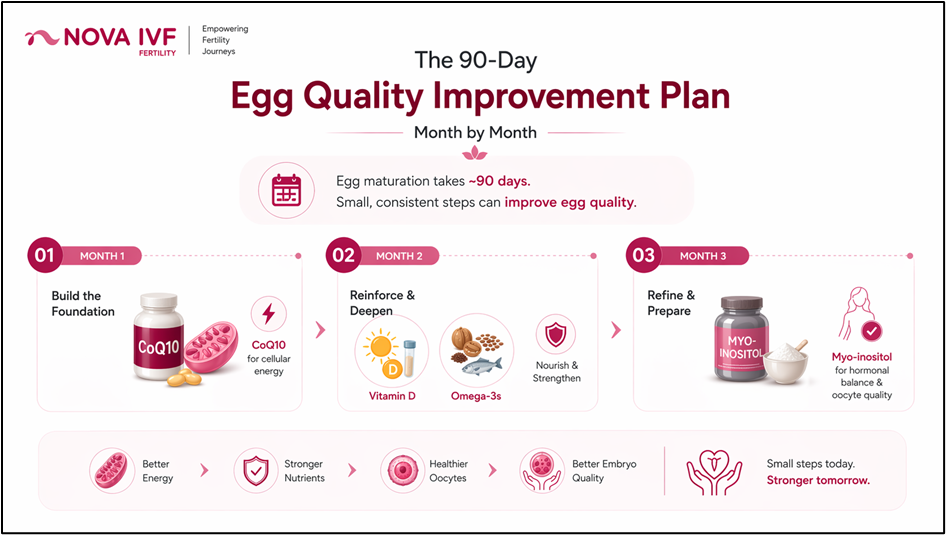
Month 1: Build the Foundation
CoQ10 (400–600mg/day) becomes really important for mitochondrial energy during egg maturation. The levels decline with age, making supplementation valuable.
Month 2: Reinforce and Deepen
Get your Vitamin D levels tested; deficiency is linked to poorer embryo quality. Add Omega-3s through walnuts, flaxseeds, or fish oil to support oocyte membrane integrity.
Month 3: Refine and Prepare
If you have PCOS or insulin resistance, myo-inositol can meaningfully improve oocyte quality.
While this can serve as a basic guide, it is always best to consult your doctor before making any dietary changes. IVF care is highly personalised, and there is no one-size-fits-all diet. Your nutrition plan should be based on your health, treatment plan, and individual needs.
Read About a comprehensive female fertility work-up
Lifestyle Factors That Directly Impact Egg Quality
Nutrition and supplements get the most attention, but these four factors have direct physiological effects on egg development and are often overlooked:
- Sleep Quality
7–8 hours of uninterrupted sleep supports melatonin. - Moderate Exercise
The insulin sensitivity and pelvic blood flow can be increased with the help of light activities. - Stress Management
Dedicated stress-reduction practices can meaningfully support hormone balance. - Alcohol Reduction
Even moderate intake increases oxidative stress and is linked to lower IVF success rates, reducing or eliminating alcohol is a high-impact change.
Learn More About how IVF treatment works
Frequently Asked Questions
Can you really improve egg quality naturally?
Yes. You cannot reverse the chromosomal baseline established by age, but you can reduce the oxidative damage and mitochondrial dysfunction that further impair egg quality.
What is the best supplement to improve egg quality for IVF?
CoQ10 (Coenzyme Q10) has the clinical evidence for improving egg quality for IVF specifically, by supporting mitochondrial energy production.
Does egg quality decline sharply after 35?
Egg quality by age shows a gradual decline through the early 30s. A more noticeable increase in chromosomal errors from 35 onwards is seen and a significant jump after 40.
How does Nova IVF assess egg quality before treatment?
At Nova IVF, egg quality test is not a single measure but a combination of factors: antral follicle count, hormone panels (including FSH and AMH for ovarian reserve context), previous cycle outcomes if applicable, age. In certain IVF cases, PGT-A may be recommended after fertilisation to assess the chromosomal status of embryos.