 Self-cycleTM IVF


-
-
-
 Infertility Counselling
-
 Female Infertility Treatment
-
 Andrology Treatment
-
 Fertility Enhancing Surgeries - Female
-
 Fertility Enhancing Surgeries - Male
-
 Endoscopy Treatment
-
 IUI Treatment
-
 IVF Treatment
-
 ICSI Treatment
-
 Advance IVF Solutions
-
 Embryology
-
 Vitrification Egg, Embryo, Sperm Freezing
-
 Preimplantation Genetic Testing (PGT)
-
 Donation Program Embryo / Egg / Sperm
-
 Self-cycleTM IVF
-
-
-
-
-
iPill Side Effects: Symptoms, Period Changes & Long-Term Effects
iPill has picked up a reputation for concerning side effects, and many people carry that worry to the pharmacy counter. However, the actual scenario is usually gentler than what the stories suggest. According to the World Health Organization (WHO), its effects are short-lived and leave no lasting harm.
Most symptoms that you might feel passes on its own within a day or two. Serious trouble is rare, and only a couple of signs like heavy bleeding or a very late period, actually mean a trip to the doctor. Knowing which few matter is most of the reassurance you need. Keep reading this blog to learn more in detail.
What Is an iPill?
iPill is an emergency contraceptive pill. Emergency contraception is a method to prevent conception following an unprotected intercourse and it can prevent 95% of pregnancies when taken within 5 days of the intercourse. It is also referred to as morning-after pill or postcoital pill. Emergency contraception can be taken in the form of either hormonal pills or intrauterine devices. It is important to understand that emergency contraception is not an alternative to regular contraceptive methods and it is important to start/ resume regular contraception after emergency contraception.
iPill is an emergency contraceptive containing the hormone levonorgestrel (LNG), a synthetic form of the hormone progesterone. According to the World Health Organization (WHO), levonorgestrel works mainly by delaying or preventing ovulation, the release of an egg. It does not cause an abortion and cannot end a pregnancy already implanted, a point FIGO also confirms. It stops a pregnancy from starting, rather than interrupting one.
iPill containing LNG is taken as a single 1.5 mg dose or 2 doses of 0.75mg each 12 hours apart, ideally to be taken within 72 hours of unprotected sex to prevent unwanted pregnancy. In India it is sold over the counter, regulated by the Central Drugs Standard Control Organisation (CDSCO), and no prescription is required.
Studies to determine the effectiveness of emergency contraception with LNG report a pregnancy rate of 1.2-2.1%.
Common Side Effects of iPill You Should Know
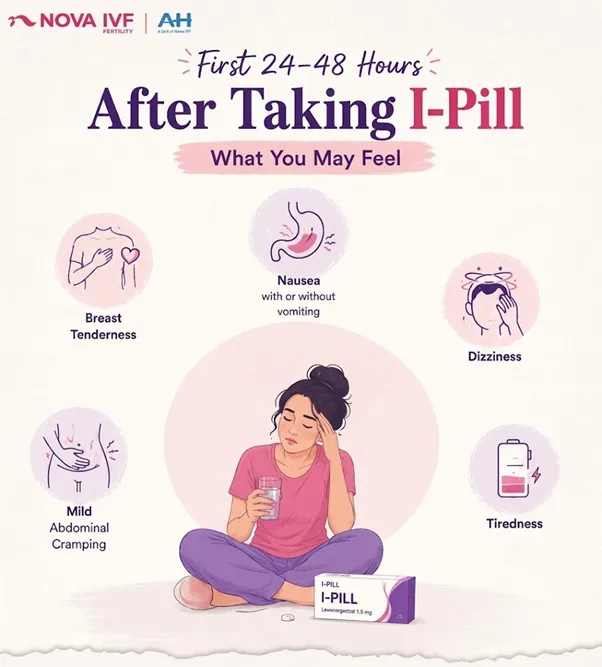
The most common side effects of iPill are mild and short-lived. The WHO describes them as usually self-limiting, easing without treatment, and much like those of ordinary contraceptive pills. Most people notice only one or two, and some notice none at all.
- Nausea, sometimes with vomiting, is the most common reaction.
- Tiredness or fatigue that eases with rest.
- Headache, and for some people mild dizziness.
- Breast tenderness or a heavy/ full feeling.
- Mild cramping low in the abdomen.
- Light spotting or a change in bleeding pattern when the next period arrives.
Vomiting is worth singling out, because it can affect the dose. According to WHO, if you vomit within 2 hours of taking an iPill, the pill may not have been fully absorbed. Rather than taking another tablet on your own, ask a specialist whether to repeat it.
How Long Do iPill Side Effects Last?
For most people, the side effects of iPill are gone within a day or two. The physical ones fade the fastest; the change to your cycle is what lingers, sometimes into the next period. Here is the rough shape of it:
- The first day usually takes the edge off the nausea, dizziness, and tiredness.
- By day two or three, most of what remains fades as the hormone clears.
- Any symptoms lingering beyond a week, especially unusual bleeding, is worth a check.
Your cycle is the slower part. One period arriving early or late is completely normal and nothing to read into. But if irregular bleeding drags on for a few weeks, it is recommended that you consult with a gynaecologist.
How Does iPill Affect Your Period?
The most common effect of iPill on periods is a shift in the timing of your next one. A brief change in flow, lighter or heavier for a cycle, can happen too. Both are common and temporary, and neither is a sign of harm.
Why the Timing of Your Period is Affected
Whether your period comes early or late depends on the stage of your cycle when you took the pill. Levonorgestrel works mainly by holding back the surge of luteinising hormone that triggers ovulation. Taken before ovulation, it delays that release, so the period that follows is pushed back too.
Taken after ovulation, it cannot delay an egg that has already been released. The period then arrives near its normal date, sometimes people may experience light spotting related to temporary hormonal changes. Either way, the shift reflects the timing of ovulation, not any harm to your cycle.
How Long Until Your Cycle Settles
According to the WHO, slight irregular bleeding after emergency contraception is common and expected, not a sign of harm. Most cycles return to their usual rhythm within 1 to 2 months. If bleeding stays irregular beyond that, it is worth having checked.
Does iPill Affect Your Long-Term Fertility?
No, iPill does not affect long-term fertility, and the long-term side effects of iPill are minimal. Levonorgestrel leaves the body within a few days, so it cannot build up or cause cumulative damage. Occasional use leaves no mark on your cycle or your ability to conceive.
Fertility returns immediately, with no waiting period after use. A single emergency pill does not reset your hormones or disturb your long-term cycle. Frequent use, however, is disuaded.
What Frequent Use Can Do
The real caution is about frequency, not a one-off dose. Emergency pills are less reliable than regular contraception, and using them often keeps the body in repeated hormonal swings. That pattern can show up in a few ways:
- Periods that turn unpredictable or irregular.
- More spotting or bleeding between periods.
- Temporary effects such as acne or mood changes.
- A harder time predicting when you ovulate.
None of these effects is permanent, and they ease once frequent use stops. If your cycle stays irregular for several months, a doctor can find out what is behind it. Occasional emergency use is rarely the cause.
When to See a Doctor
Most reactions to iPill warrant nothing more than rest and a little time. A few signs, though uncommon, are worth acting on promptly. See a doctor if you notice any of the following:
- Very heavy bleeding that soaks a pad or more each hour.
- Severe or one-sided pain low in the abdomen.
- Bleeding that lasts longer than about a week.
- No bleeding at all, with a period more than seven days late.
- Severe dizziness or fainting, rather than the mild kind that settles with rest.
iPill lowers the chance of pregnancy without removing it entirely, so a period over a week late is worth a home pregnancy test. If it is positive, or you are unsure, consult a fertility specialist at Nova IVF Fertility. We will help evaluate your cycle and hormones and plan a treatment plan according to your individual necessities.
Frequently Asked Questions
Is an iPill the same as an abortion pill?
They are not the same. iPill only delays the egg's release, so it can stop a pregnancy from starting but cannot end one that has already begun. An abortion pill does the opposite, and it is taken under a doctor's care.
Can iPill delay periods by more than a week?
Most of the time it will not. Your period usually turns up within a week of the date you expect, whether early or late. If it runs more than seven days over, take a home pregnancy test to be safe.
Is it safe to take an iPill more than once in a cycle?
It will not harm you, but it is not a good habit. Taking it more than once in the same cycle often leaves your bleeding irregular and makes it less reliable. If you need protection regularly, ordinary birth control is a better fit.
What are the disadvantages of iPill?
A few things are worth knowing. In the short term it can bring on nausea, tiredness, or a shifted cycle. It also does nothing to guard against sexually transmitted infections. And as a routine method, it simply does not work as well as proper contraception.