 Self-cycleTM IVF


-
-
-
 Infertility Counselling
-
 Female Infertility Treatment
-
 Andrology Treatment
-
 Fertility Enhancing Surgeries - Female
-
 Fertility Enhancing Surgeries - Male
-
 Endoscopy Treatment
-
 IUI Treatment
-
 IVF Treatment
-
 ICSI Treatment
-
 Advance IVF Solutions
-
 Embryology
-
 Vitrification Egg, Embryo, Sperm Freezing
-
 Preimplantation Genetic Testing (PGT)
-
 Donation Program Embryo / Egg / Sperm
-
 Self-cycleTM IVF
-
-
-
-
-
Multiple Pregnancy: Types, Causes, and What Expecting Mothers Must Know
A multiple pregnancy means that two or more babies develop in the womb at the same time. The most common form is twins, though triplets and higher numbers also occur. Learning that more than one baby is on the way can bring excitement and worry in the same breath.
Multiple births have become more common in India over the past two decades. Two shifts explain most of the change. Wider use of IVF treatment and a rise in maternal age at first pregnancy now account for much of the increase.
If you are carrying twins or triplets, a few questions guide everything that follows.
Are the babies identical or fraternal?
What caused the pregnancy, and which risks need a closer eye?
Once your doctor knows those answers, the monitoring plan falls into place, and it is important to note that starting it early matters a lot.
What Is a Multiple Pregnancy? Twins, Triplets, and Beyond
A multiple pregnancy is any pregnancy that carries more than one foetus. Twins are two babies and triplets are three, while four or more is uncommon. Doctors describe three or more as a high-order multiple, because monitoring and delivery planning intensify at that point.
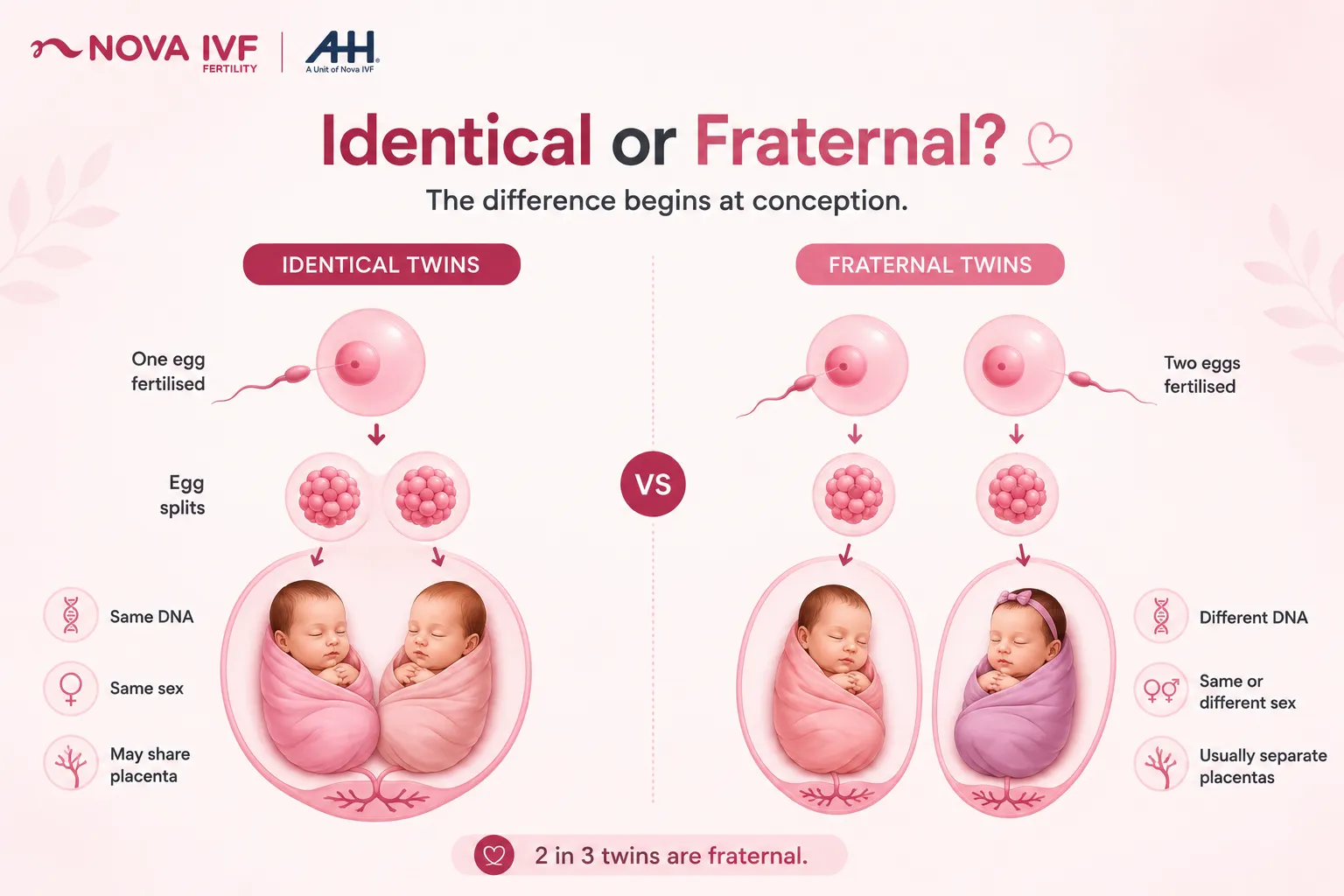
Multiples form in one of two ways, and the difference is set at conception. A single fertilised egg can split into two embryos, producing monozygotic (identical) twins. Alternatively, the ovaries release more than one egg in a cycle, and separate sperm fertilise each, producing dizygotic (fraternal) twins.
Did you know? Identical and fraternal multiples are not exactly common. About 2/3rds of twins are fraternal, formed from two separate eggs. Identical twins are rarer and occur at a fairly steady rate worldwide, largely independent of age, family history, or fertility treatment.
How Is Identical Multiple Pregnancy Different from Fraternal?
Whether twins are identical or fraternal is fixed at fertilisation and does not change. This origin determines how much DNA the babies share and how closely the pregnancy is monitored. Chorionicity, meaning whether the twins share a placenta, is the feature that matters most for safety.
| Feature | Identical (Monozygotic) | Fraternal (Dizygotic) |
|---|---|---|
| How it forms | One fertilised egg splits | Two or more eggs fertilised separately |
| Genetic material | Share the same DNA | Share about half, like siblings |
| Sex | Always the same sex | Can be the same or different |
| Placenta | Often share one placenta (monochorionic) | Usually separate placentas |
| Monitoring need | Higher, due to shared-placenta risks | Standard multiple-pregnancy monitoring |
Chorionicity drives much of the monitoring plan. When identical twins share one placenta, blood can flow unevenly between them, a condition called twin-to-twin transfusion syndrome. Because of this risk, doctors confirm the placenta type early and arrange more frequent scans.
Causes of Multiple Pregnancy: Natural and Treatment-Related Factors
The causes of multiple pregnancy fall into two groups. Natural factors make the release of more than one egg more likely, while treatment-related factors arise from fertility care. Both have grown more relevant in India as more couples use assisted reproduction.
Twinning rates vary by region and by whether conception was natural or assisted. The same 2018 review reports that twin pregnancies account for 2 to 4 percent of all births worldwide. Spontaneous twinning in South and Southeast Asia, including India, sits at the lower end, under 8 per 1,000 births.
Several natural factors are associated with a higher chance of conceiving multiples.
- Advanced maternal age, particularly after 35, is linked with a higher chance of releasing more than one egg in a cycle.
- A family history of fraternal twins on the mother's side tends to raise the likelihood of releasing multiple eggs.
- Having had several previous pregnancies is associated with a slightly higher chance of multiples in later ones.
How Does IVF Increase the Chances of a Twin or Triplet Pregnancy?
IVF raises the chance of multiples through how embryos are transferred. Placing more than one embryo to improve implantation also means more than one can implant, so a twin or triplet pregnancy is more common after IVF. Nova's explainer on IVF and twins sets out how often this actually happens.
A common belief is that transferring several embryos raises success rates. That logic held some truth in the early years of IVF, when implantation was less reliable. Modern embryo freezing and advanced IVF solutions have changed the maths, so the safer practice now is elective single embryo transfer.
Single embryo transfer trades a small dip in per-cycle odds for a large drop in multiple-pregnancy risk. Honest IVF success rates, reported by age band, help patients weigh that trade-off rather than chase the highest headline number. The aim is one healthy baby at a time.
Expert tip: If you are planning an IVF treatment and want to lower the chance of twins or triplets, ask your specialist directly about single embryo transfer. Ask how it changes your personal success odds by age. A clear, age-specific answer is a good sign of an honest clinic.
Early Signs and Symptoms of Multiple Pregnancy
Some women suspect a multiple pregnancy before any scan confirms it. The early signs tend to be stronger versions of ordinary pregnancy symptoms, driven by higher pregnancy hormone levels. None of them prove anything on their own, but together they can prompt an earlier ultrasound.
The signs that more than one baby may be present include the following.
- Morning sickness often feels more severe and starts earlier than in a single pregnancy.
- Weight gain in the first trimester can be faster than expected for the dates.
- Levels of the pregnancy hormone hCG tend to run higher, which a blood test can flag.
- Breast tenderness is frequently more pronounced and appears sooner.
- Fatigue can feel extreme, beyond the tiredness most early pregnancies bring.
An ultrasound remains the only reliable way to count the babies and check chorionicity. Most multiples are confirmed at the first or second routine scan. Chorionicity is easiest to determine before 14 weeks, which is why an early scan matters.
Important note: A higher hCG reading or strong symptoms can suggest twins, but only a scan can confirm it. If your early symptoms feel unusually intense, mention this at your next appointment. An early dating scan can settle the question and start the right monitoring sooner.
Complications of Multiple Pregnancies: Risks Every Mother Should Know
Carrying more than one baby raises the risk of certain complications for both mother and babies. This is general information and not a substitute for medical advice, since every pregnancy differs. Care should always be guided by a specialist who knows the individual case.
According to ACOG, more than half of twins are born preterm, and triplets and higher-order multiples are almost always born before 37 weeks. The other common risks follow from the extra load on the body.
The complications of multiple pregnancies that doctors watch for include the following.
- Preeclampsia and high blood pressure appear more often, and frequently earlier, than in single pregnancies.
- Gestational diabetes is more common, because two or more placentas place a heavier load on the body.
- Anaemia develops more easily, since the body must supply iron and nutrients to more than one baby.
- Postpartum bleeding is more likely, because a larger, more stretched uterus contracts less efficiently after birth.
- Twin-to-twin transfusion syndrome can affect identical twins who share one placenta, when blood flow between them becomes unequal.
None of these outcomes is certain, and many never occur. Detecting rising blood pressure or slowed fetal growth early allows timely treatment or planned delivery. Frequent scans, blood-pressure checks, and growth tracking are the main tools for managing these risks.
Why Triplet Pregnancy Requires Closer Specialist Monitoring
A triplet pregnancy sits in the high-order multiple category, where the risks rise more steeply. Very early delivery is far more likely, and admission to a neonatal intensive care unit is common for triplets. The mother faces higher rates of preeclampsia, anaemia, and bleeding than in a twin pregnancy.
Triplet care usually involves the steps below.
- Monitoring is structured and frequent from the first trimester onward.
- Care is led by a specialist in high-risk and multiple gestations, often with a fetal medicine specialist.
- Delivery is usually planned by caesarean, well before 37 weeks, to protect mother and babies.
- Antenatal corticosteroids are often given before a planned preterm delivery to help the babies' lungs mature. Delivery is arranged at a centre with a neonatal intensive care unit on site. This planning aims for the safest achievable timing for mother and babies.
How Nova IVF Supports a Multiple Pregnancy
Nova IVF Fertility's part in a multiple pregnancy begins before conception. Wherever clinically suitable, Self-cycle IVF with a woman's own eggs is the default, and single embryo transfer keeps the chance of twins or triplets lower.
The embryology laboratories meet NABL standards and the centres hold NABH accreditation. Beyond the first trimester, care passes to an obstetrician or fetal medicine specialist for high-risk monitoring and delivery.
A short message to the nearest Nova IVF Fertility treatment centre is a simple way to begin. The team can outline the early scans and the specialists involved. Booking the first scan and a specialist referral early keeps monitoring on schedule from the start.
Frequently Asked Questions
Is a triplet pregnancy safe?
A triplet pregnancy carries higher risks than a twin pregnancy, though early, structured specialist monitoring helps most cases reach a safe outcome. The main concern is very preterm birth, which is why delivery is usually planned early.
What is the main cause of twins?
Fraternal (dizygotic) twins, the more common type, form when two eggs are released and fertilised separately. Identical (monozygotic) twins form when one fertilised egg splits. Older maternal age and family history are linked with the fraternal type.
What are the early signs of a multiple pregnancy?
Stronger morning sickness, faster early weight gain, higher hCG, and marked fatigue can all suggest more than one baby. However, none of these is conclusive; only an ultrasound can confirm how many babies are present.
Can a multiple pregnancy happen without IVF?
Yes, most twins are conceived naturally, more often with older maternal age or a family history of fraternal twins. IVF is associated with a higher chance mainly when more than one embryo is transferred.