 Self-cycleTM IVF


-
-
-
 Infertility Counselling
-
 Female Infertility Treatment
-
 Andrology Treatment
-
 Fertility Enhancing Surgeries - Female
-
 Fertility Enhancing Surgeries - Male
-
 Endoscopy Treatment
-
 IUI Treatment
-
 IVF Treatment
-
 ICSI Treatment
-
 Advance IVF Solutions
-
 Embryology
-
 Vitrification Egg, Embryo, Sperm Freezing
-
 Preimplantation Genetic Testing (PGT)
-
 Donation Program Embryo / Egg / Sperm
-
 Self-cycleTM IVF
-
-
-
-
-
What Is Embryo Transfer in IVF? Types, Step-by-Step Procedure and What to Expect in India
Embryo Transfer: What Happens, When It Happens and What to Expect
Embryo transfer is often described as the final step of IVF, but for most patients, it feels more like the beginning of a completely different phase.
The intense monitoring and procedures may be over, yet this is usually when questions around implantation, timing, success rates, body changes, and recovery become much more personal and emotionally consuming.
Since the egg transfer directly connects embryo development with the possibility of pregnancy, even small details around the procedure tend to feel important and worth understanding clearly.
What Is Embryo Transfer and When Does It Happen in IVF?
Embryo transfer is the last step of IVF. It happens after stimulation, egg retrieval, fertilisation, and a few days of embryo development in the lab. Most doctors prefer transferring on Day 5 rather than Day 3. By Day 5, only the embryos with genuine potential have reached the blastocyst stage.
The ones that do not make it tell you something too. Transferring at this point lowers the chance of picking an embryo with chromosomal problems. Your embryologist will decide the exact day based on how your embryos are developing.
Types of Embryo Transfer in IVF
The transfer approach is not the same for every patient. It comes down to how the body responded to stimulation, where hormone levels stand, the condition of the uterus, and whether genetic testing needs to happen before transfer.
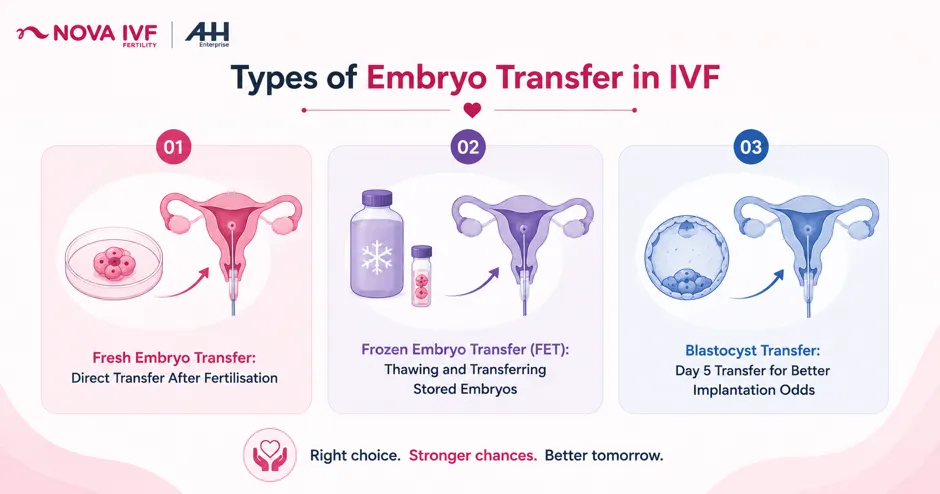
Fresh Embryo Transfer: Direct Transfer After Fertilisation
A fresh IVF embryo transfer takes place in the same cycle as egg retrieval, on Day 3 or Day 5. When hormone levels are stable and the body has responded well, this is a more direct route.
That changes when Ovarian Hyperstimulation Syndrome (OHSS) risk is high, progesterone rises too soon, or genetic testing is on the plan. In those situations, vitrification for embryo and egg freezing is a better call, preserving the embryos now and transferring when the body is in a better condition.
Frozen Embryo Transfer (FET): Thawing and Transferring Stored Embryos
With FET, embryos are preserved through embryo freezing and transferred in a later cycle, after the body has had a full cycle to recover. The uterus is no longer dealing with stimulating hormones, which tends to work in the embryo's favour.
Genetic testing can also be completed before the transfer rather than after. Frozen transfer success rates today are on par with fresh, and in many cases, the numbers are better.
Single vs Multiple Embryo Transfer: How Many Embryos Are Transferred?
Alongside the type and day of transfer, one more decision shapes the outcome: how many embryos go back. In most cases today, that number is one, sometimes two. Transferring more does not improve your chances, and it can raise real risks for you and the baby.
What a Single Embryo Transfer Means
A single embryo transfer places one embryo into the uterus. Years ago, when Day 3 embryos were used, two or three were often transferred together to lift the odds. Now that Day 5 blastocysts implant well on their own, transferring one, or at most two, is the standard.
Why More Embryos Do Not Raise Your Chances
A common belief is that more embryos mean a higher pregnancy rate. This is not true. Once an embryo has genuine potential, adding a second or third mainly adds the chance of a twin or triplet pregnancy, not a better result.
A multiple pregnancy carries higher risks of miscarriage, preterm birth, and low birth weight. Babies born too early may need newborn intensive care. That care can cost far more than the transfer itself, on top of the health toll
Who Is Advised a Single Embryo Transfer
Some patients are clear candidates for one embryo. Dr Pratibha Singh, a fertility specialist in Varanasi, looks at certain factors such as the uterus, age, overall health, and embryo quality before deciding. A single transfer is usually advised for:
- Women who already have a living child
- A uterus with a structural difference, such as a unicornuate or bicornuate uterus
- Advanced maternal age, or conditions like high blood pressure or diabetes
- Young women whose embryo quality is very good
The aim is not just a positive test, but a healthy baby who goes home well. “Our fertility treatment center in varanasi assesses the age, uterus, and embryo quality before fixing the number. For most patients, one well-chosen embryo is the safest route to that outcome.”, says Dr Pratibha Singh
Blastocyst Transfer: Day 5 Transfer for Better Implantation Odds
A blastocyst transfer means transferring an embryo that has reached Day 5 or Day 6 of development. At this stage, the embryo consists of approximately 200 to 300 cells and has a meaningfully higher implantation potential than a Day 3 embryo.
Not every embryo reaches the blastocyst stage, which is exactly what makes this a useful natural filtering process. The embryologist advises on whether Day 3 or Day 5 is more appropriate based on embryo quality and the number available.
The Embryo Transfer Procedure: Step by Step
The egg transfer procedure takes around 10 to 15 minutes and needs no general anaesthesia. Here is what happens at each stage:
- Uterine check: Endometrial thickness and pattern are confirmed on ultrasound before anything begins
- Full bladder: You will be asked to come with a full bladder, as this helps the doctor see the uterus clearly during the procedure
- Catheter insertion: A soft, thin catheter is passed gently through the cervix into the uterine cavity
- Embryo placement: The embryo is released at the right position inside the uterus under real-time ultrasound guidance
- Rest after transfer: You rest at the clinic for 15 to 30 minutes before going home
Fresh vs Frozen Embryo Transfer: Which Is Better for You?
The right choice is always clinical, not a personal preference. Here is a quick comparison:
| Factor | Fresh Transfer | Frozen Transfer |
|---|---|---|
| Timing | Same cycle as retrieval | Separately prepared cycle |
| OHSS risk | Higher | Eliminated |
| PGT-A testing | Not possible | Possible before transfer |
| Uterine receptivity | Affected by stimulation | More natural state |
| Best suited for | Good responders, normal progesterone | PCOS, high responders, genetic testing needed |
FAQs
Is the embryo transfer procedure painful?
The procedure causes minimal discomfort for most patients. Mild pressure and brief cramping are possible but typically resolve within hours.
What is the difference between fresh and frozen embryo transfer?
In fresh embryo transfer, the eggs are transferred during the same cycle as the egg retrieval. In a frozen embryo transfer, the embryos are frozen and transferred in a different cycle.
How many days after egg retrieval does embryo transfer happen?
Fresh transfers occur on Day 3 or Day 5 after retrieval. Frozen transfers typically happen in the following cycle, around 4 to 8 weeks after retrieval.
What should I avoid after embryo transfer to improve success chances?
Strenuous exercise, extreme heat, alcohol, and high psychological stress are best avoided. Your fertility team will provide personalised post-transfer guidance.