 Self-cycleTM IVF


-
-
-
 Infertility Counselling
-
 Female Infertility Treatment
-
 Andrology Treatment
-
 Fertility Enhancing Surgeries - Female
-
 Fertility Enhancing Surgeries - Male
-
 Endoscopy Treatment
-
 IUI Treatment
-
 IVF Treatment
-
 ICSI Treatment
-
 Advance IVF Solutions
-
 Embryology
-
 Vitrification Egg, Embryo, Sperm Freezing
-
 Preimplantation Genetic Testing (PGT)
-
 Donation Program Embryo / Egg / Sperm
-
 Self-cycleTM IVF
-
-
-
-
-
Types of Preimplantation Genetic Testing (PGT): A Complete Guide to PGT-A, PGT-M, PGT-SR
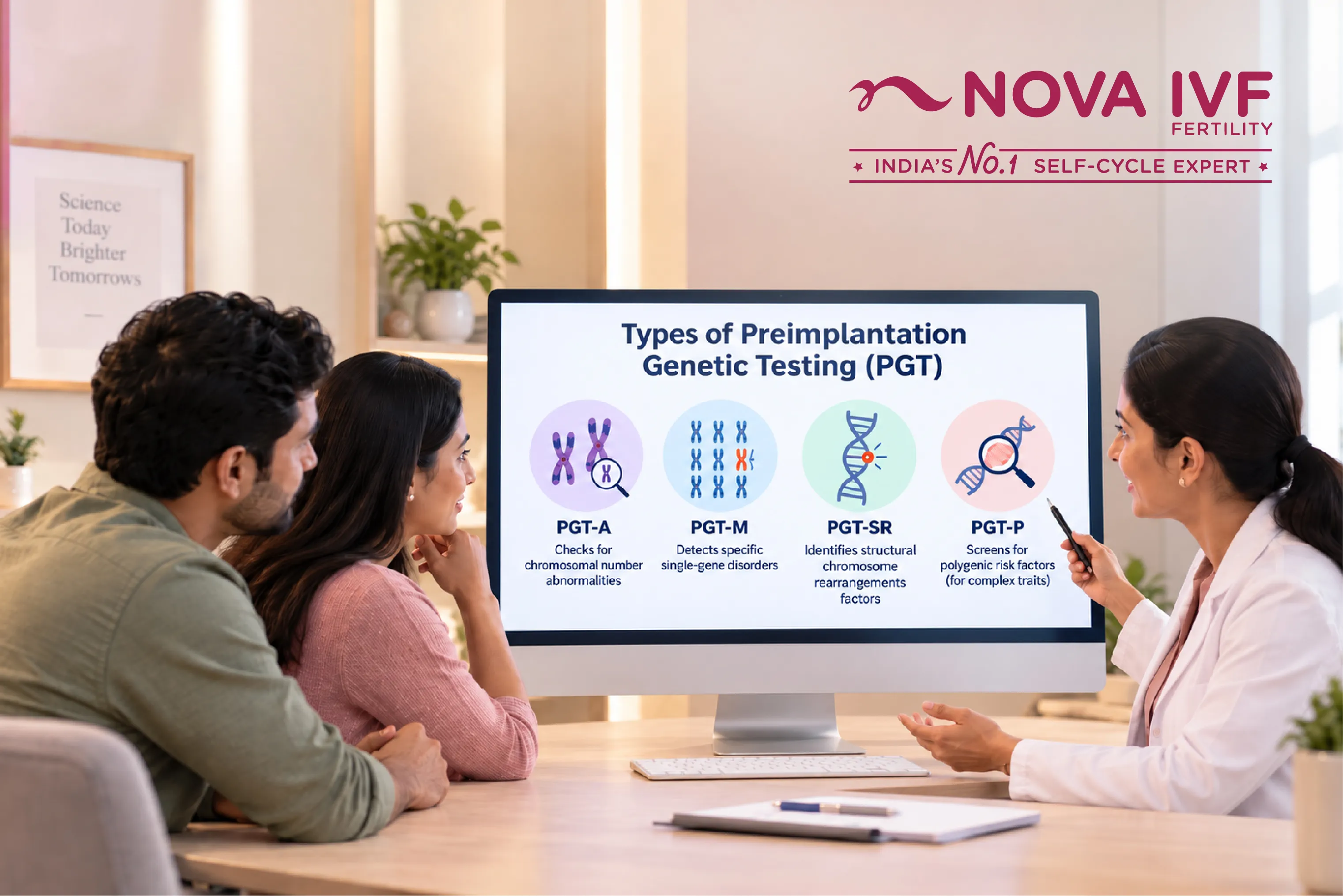
If you've been advised to undergo genetic testing as part of your IVF treatment, you've probably come across terms like PGT-A, PGT-M, or PGT-SR and wondered what they mean. While they all involve testing embryos before transfer, each serves a different purpose and is recommended based on your medical history, fertility diagnosis, or the risk of passing on a genetic condition.
Understanding these different types of Preimplantation Genetic Testing can help you have more informed discussions with your fertility specialist and better understand why a particular test may be recommended as part of your treatment plan.
What is PGT?
Preimplantation Genetic Testing (PGT) is a specialized laboratory procedure used during In Vitro Fertilization (IVF) to analyze the genetic material of embryos before implantation. Clinicians remove a few cells from the outer layer of a 5-day or 6-day blastocyst, known as the trophectoderm, and send them for genomic analysis. This evaluation identifies specific genetic issues so embryologists can select embryos with the highest likelihood of leading to a successful pregnancy.
Historically, doctors referred to embryo screening as Preimplantation Genetic Diagnosis (PGD) or Preimplantation Genetic Screening (PGS). Modern reproductive medicine consolidated these definitions under the term Preimplantation Genetic Testing (PGT). PGD now specifically maps to PGT-M and PGT-SR, which diagnose specific inherited conditions, while PGS maps to PGT-A, which screens for general chromosomal counts.
Depending on what needs to be evaluated, PGT is divided into three main types, each designed to detect a different type of genetic or chromosomal abnormality.
PGT-A: Screening for Chromosomal Abnormalities
Preimplantation Genetic Testing for Aneuploidy (PGT-A) screens embryos to ensure they contain the correct total number of chromosomes. Healthy human embryos carry 46 chromosomes, arranged in 23 pairs. An incorrect number of chromosomes is called aneuploidy. PGT-A evaluates the number of chromosomes in an embryo to identify numerical abnormalities before embryo transfer.
What PGT-A looks for
PGT-A checks for missing chromosomes (monosomy), extra chromosomes (trisomy), and, in some cases, mosaicism, where an embryo contains a mixture of normal and abnormal cells. Conditions such as Down syndrome (Trisomy 21) and Turner syndrome (Monosomy X) are examples of chromosomal abnormalities that PGT-A can detect.
While PGT-A can identify embryos with the correct number of chromosomes, it cannot detect single-gene disorders such as cystic fibrosis or guarantee that a genetically normal (euploid) embryo will result in a successful pregnancy.
When PGT-A may be recommended
PGT-A may be considered for individuals with:
- Advanced maternal age (typically 35 years or older)
- Repeated IVF implantation failures
- Severe male factor infertility
- A history of recurrent miscarriages
According to a study published in the Journal of Assisted Reproduction and Genetics, as featured in NLM, clinical research demonstrates that for high-risk patients with a history of recurrent miscarriages, screening embryos with PGT-A reduces early pregnancy loss from 75% down to 18.1% and raises live birth rates per transfer to 50%.
PGT-M: Testing for Inherited Single-Gene Disorders
Preimplantation Genetic Testing for Monogenic/Single-Gene Disorders (PGT-M) targets specific gene mutations passed down from one or both biological parents. Unlike PGT-A, which counts full chromosomes, PGT-M looks for specific mutations within individual genes that are known to cause inherited disorders.
When PGT-M is recommended
PGT-M may be recommended when one or both partners are known carriers of a genetic condition, have a family history of an inherited disorder, or already have a child affected by a genetic disease. Before testing embryos, laboratories develop a customised test based on the family's known genetic mutation.
Some conditions that can be tested include:
- Autosomal dominant disorders: Huntington's disease, Marfan syndrome
- Autosomal recessive disorders: Cystic fibrosis, sickle cell disease, Tay-Sachs disease, Thalassemia
- X-linked disorders: Hemophilia, Duchenne muscular dystrophy
Unlike PGT-A, PGT-M focuses on specific gene mutations and does not automatically assess whether an embryo has the correct number of chromosomes.
PGT-SR: Detecting Structural Chromosomal Rearrangements
Preimplantation Genetic Testing for Structural Rearrangements (PGT-SR) evaluates embryos when one or both parents carry a structural abnormality in their own chromosome layout. While the parents themselves are usually healthy because their genetic material is balanced, their embryos may inherit an unbalanced chromosome arrangement, increasing the risk of implantation failure, miscarriage, or certain genetic conditions.
What PGT-SR looks for
PGT-SR evaluates embryos for structural chromosome abnormalities, including:
- Reciprocal translocations: Pieces of two chromosomes exchange places
- Robertsonian translocations: Two chromosomes become joined together
- Inversions: A chromosome segment breaks, reverses, and reattaches
When PGT-SR is recommended
PGT-SR is typically recommended for individuals with balanced translocations or inversions identified through karyotype testing or those with a history of recurrent pregnancy loss linked to structural chromosomal abnormalities. The aim is to identify embryos with balanced or normal chromosome structures before transfer.
How Does Your Fertility Specialist Decide Which Type of PGT You Need?
Before recommending a specific type of PGT, your fertility specialist will discuss your medical and family history, previous fertility treatments, and the purpose of genetic testing.
As Dr. Yamini Agarwal, a fertility specialist in Siliguri, explains that genetic counselling is an essential part of the process. It helps you understand why a particular type of PGT may be recommended, what the test can and cannot detect, and how the results may influence your treatment plan. This counselling approach is followed at our fertility clinic in Siliguri and across all Nova IVF Fertility centres to help patients make informed decisions with a clear understanding of their testing options and results.
Here are some factors considered when choosing among the different types of Preimplantation Genetic Testing.
Age
Advanced maternal age increases the risk of random chromosomal errors during egg maturation, making PGT-A the standard choice for women over 35.
Family history
A documented history of genetic conditions across generations signals the need for PGT-M to test for specific monogenic traits.
Carrier screening results
Expanded carrier screening done before IVF shows whether prospective parents carry matching recessive gene mutations. If both partners carry the same recessive gene mutation, PGT-M may be recommended.
Previous miscarriages
Depending on the underlying cause, your fertility specialist may recommend PGT-A or further investigations, such as parental karyotyping, to determine whether PGT-SR is appropriate.
Chromosomal abnormalities
A blood test called a karyotype reveals whether a parent carries balanced translocations, directly indicating a need for PGT-SR.
Fertility diagnosis
Certain fertility diagnoses, including severe male factor infertility or repeated unexplained IVF failures, may influence whether PGT-A is considered.
Conclusion
Receiving a recommendation for PGT can feel overwhelming, especially when you're faced with unfamiliar terms and testing options. Remember that each type of Preimplantation Genetic Testing is recommended for a specific reason. Rather than deciding on a test yourself, the most important step is to have an open discussion with your fertility specialist, who can explain what is appropriate for your situation and answer any questions you may have.
Frequently Asked Questions
Does everyone undergoing IVF need genetic testing?
No, genetic testing is not mandatory for every IVF patient. Patients with good prognoses, young age, and no family history of genetic disorders often achieve successful pregnancies without PGT.
Can one embryo undergo more than one type of PGT?
Yes, laboratories can perform PGT-M or PGT-SR alongside PGT-A on the same biopsy sample. This combination ensures the embryo is free from the specific inherited condition and carries the correct total chromosome count.
Does PGT guarantee a healthy baby?
No, PGT does not guarantee a healthy baby. PGT increases pregnancy rates per transfer and reduces miscarriage risks, but it cannot test for every possible health condition or override non-genetic factors involved in pregnancy.
Can You Choose Which Type of PGT to Have?
You cannot choose a type of PGT for yourself. PGT-M and PGT-SR require specific medical indications and custom-built laboratory tests based on confirmed genetic diagnoses. While PGT-A is an elective choice for many IVF patients, your fertility specialist will guide you toward the testing protocol that directly matches your medical needs.