 Self-cycleTM IVF


-
-
-
 Infertility Counselling
-
 Female Infertility Treatment
-
 Andrology Treatment
-
 Fertility Enhancing Surgeries - Female
-
 Fertility Enhancing Surgeries - Male
-
 Endoscopy Treatment
-
 IUI Treatment
-
 IVF Treatment
-
 ICSI Treatment
-
 Advance IVF Solutions
-
 Embryology
-
 Vitrification Egg, Embryo, Sperm Freezing
-
 Preimplantation Genetic Testing (PGT)
-
 Donation Program Embryo / Egg / Sperm
-
 Self-cycleTM IVF
-
-
-
-
-
Embryo Grading in IVF: What the Grades Mean and Why They Matter
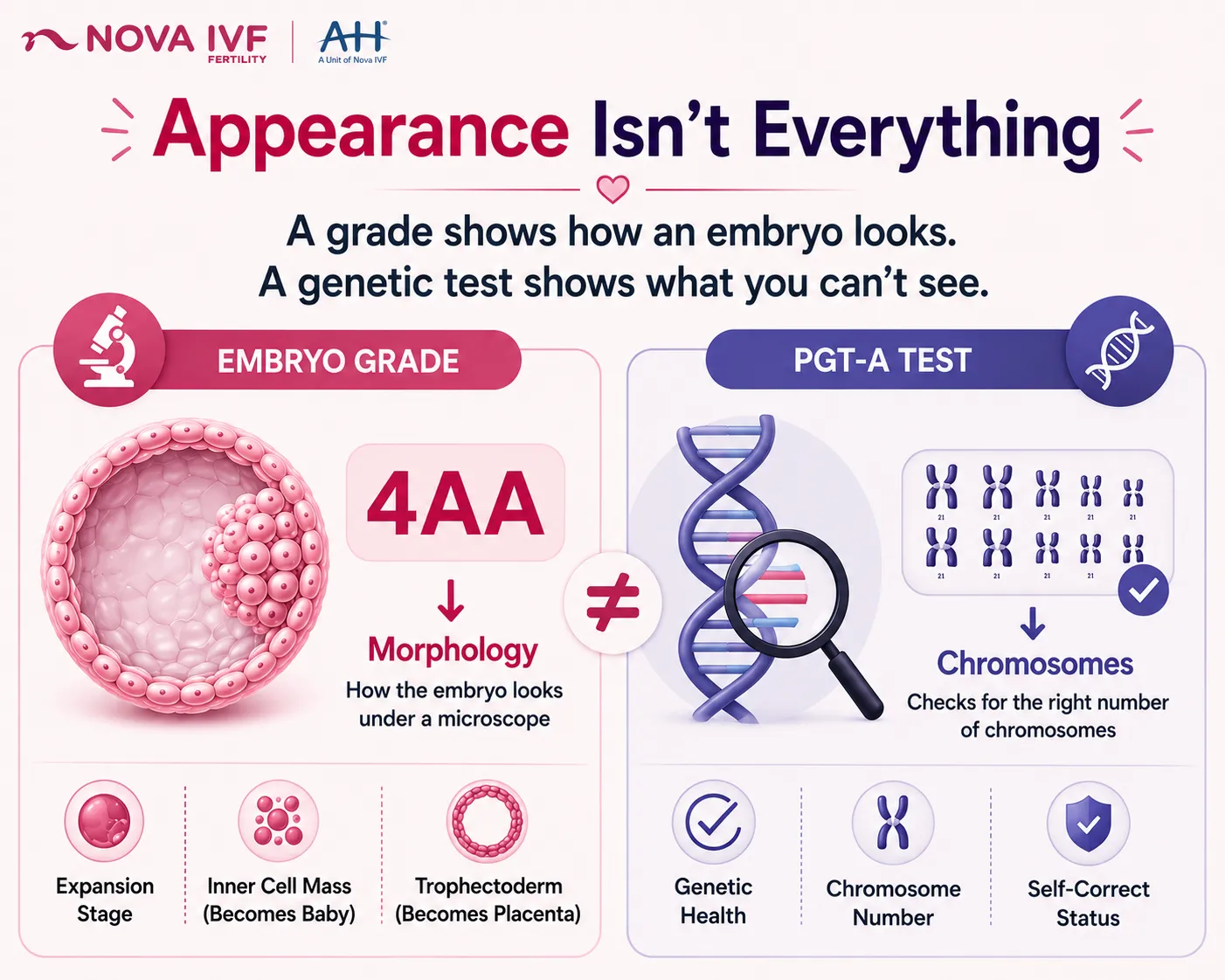
Embryo grading in IVF is an assessment method with which a fertility specialist monitors how an embryo looks under the microscope on a given day. A higher grade describes an embryo that has developed well so far. The score reflects cell number, symmetry, and expansion, but it cannot read chromosomes or predict implantation.
Over three to five days after egg retrieval, the fertilised eggs develop into embryos in the lab. The grade helps the team to decide which embryo to transfer first and which to freeze. An embryo grading chart maps each code to the feature it describes
What Is Embryo Grading and How Does It Work?
Embryo grading is a visual assessment that a trained embryologist performs through a microscope. Grading relies on observation alone, so the embryo is never handled or disturbed. And since nothing is added or removed, the same embryo stays viable for transfer or freezing straight afterward.
A fertility specialist assesses the embryo at two specific points in its development. The first is around Day 3, at the cleavage stage of a few cells. The second is around Day 5, at the blastocyst stage, and each point is graded on different features.
Day 3 Embryo Grading
On Day 3, the embryo is at the cleavage stage, meaning an early embryo of just a few cells. A healthy one usually has about six to eight cells. The embryologist checks the cell count, how even the cells are, and the fragmentation, or tiny broken-off bits of cell.
Some fragmentation is completely normal and does not rule an embryo out. Many embryos with a small amount of it still develop well and lead to healthy pregnancies. A Day 3 grade is an early snapshot, since some morphologically average embryos continue to develop by Day 5.
Blastocyst Grades on Day 5
By Day 5, a well-developed embryo reaches the blastocyst stage, an expanded structure with a fluid-filled centre and two distinct cell types. Blastocyst culture holds the embryo in controlled lab conditions for the extra days it needs to reach this stage. Roughly a third to half of embryos reach it.
The American Society for Reproductive Medicine publishes the Gardner grading scale that most labs use for a blastocyst. The system assigns one number and two letters, written as a code such as 4AA. The number reflects growth, and the two letters rate the two cell types.
| Part of the code | In plain terms | Range |
|---|---|---|
| The number (1 to 6) | How much the blastocyst has grown and begun to hatch | 1 is early, 6 is fully hatched |
| First letter (A to C) | Quality of the cells that become the baby (inner cell mass) | A strongest, C weakest |
| Second letter (A to C) | Quality of the cells that become the placenta (trophectoderm) | A strongest, C weakest |
So 4AA describes a well-expanded blastocyst with grade A quality in both cell types. Reading a code from left to right gives you the expansion stage and then the two cell-layer grades.
The grade summarises the embryo's development up to that day. It points to developmental potential rather than a guaranteed outcome. A blastocyst transfer uses this assessment to decide which embryo to place first.
Which Embryo Grades Are Usually Transferred First?
When several blastocysts are available, the team usually begins with the highest-grading embryos. Fully expanded blastocysts with grade A cell layers are associated with a higher chance of implantation per transfer.
- Grades like 4AA and 5AA, which are fully expanded with strong cells throughout.
- Grades like 4AB and 5AB, which are nearly as strong, with one slightly lower cell layer.
- Lower grades such as 3BC or 4BC, which are still used and have produced healthy babies.
So the higher grades are generally used first, though they are not the only ones that succeed. At Nova IVF Fertility, the fertility specialists weigh the grade alongside your age and past cycles. The embryo transfer decision rests on all of these factors, not the grade alone.
Every transfer decision also weighs the health of the uterine lining and your treatment history. Individual clinical situations vary, so treatment decisions should be made in consultation with a qualified reproductive medicine specialist.
Does Embryo Grade Predict IVF Success?
Higher-grade blastocysts tend to implant more often per transfer, which is why grade guides the transfer order. A 2015 review in the International Journal of Fertility and Sterility calls this an observed morphological link, not a proven cause. So a strong grade is a favourable sign, not a guarantee.
A higher-grade embryo can still carry the wrong number of chromosomes, and a lower-grade embryo can be chromosomally normal. Grading cannot detect this, because it assesses appearance rather than genetic health. It is also why chromosomal errors grow more likely as maternal age rises, whatever the grade shows.
How Grading and PGT-A Differ
Grading and a genetic test answer different questions, and one cannot substitute for the other. Grading reads the embryo's structure, while a chromosome test reads its genetic content. PGT-A biopsies a few trophectoderm cells, so it is usually run only on embryos that reach the blastocyst stage.
- Embryo grading is a visual, morphological score of how the embryo looks, which guides the transfer order but cannot read chromosomes.
- PGT-A is a laboratory test that examines the embryo's chromosomes directly, detecting genetic status that grading cannot see.
Some online material oversells the grade, treating one code as a guarantee or a reason to discard an embryo. A blastocyst can also expand further within hours, so its number can rise on the same day. It is a starting point for the transfer decision, so it is best not to associate it with a verdict.
How Nova IVF's Embryologists Use Grading to Personalise Your Transfer Decision
At Nova IVF Fertility, the grade is where the conversation starts, not where it ends. The embryologist reads it alongside everything else known about your cycle, then reviews the options with your doctor. These other factors can move the order away from the numerically highest grade.
- The quality of the egg and sperm, which shaped how the embryo developed from the start.
- How ready the uterine lining is, since even a well-graded embryo needs a receptive lining to implant.
- Your age, which affects the chance that a high-grade embryo is also chromosomally normal.
- Your earlier cycles, including how past embryos and transfers behaved.
- How many blastocysts you have, which affects whether to use the top one now or freeze it.
Newer tools such as AI embryo selection give the embryologist a consistent second opinion on each embryo. The system scores developmental features and supports, rather than replaces, the embryologist's judgement. Many such systems analyse time-lapse images of the embryo's growth, capturing changes a single daily check can miss.
Once the order is clear, the team decides what to transfer now and what to keep. Embryo freezing preserves the remaining blastocysts through vitrification for a future cycle. Vitrified blastocysts survive thawing in the large majority of cases, keeping the remaining ones available for a later transfer.
Frequently Asked Questions
What is the best embryo grade for IVF transfer?
4AA and 5AA blastocysts are usually transferred first, because they implant most often. Grade reflects appearance, not genetic health, so lower grades still succeed. Embryologists choose based on the grade, your age, and which embryos are available.
What do embryo grades like 4AA and 3BB mean?
The number is the blastocyst's expansion stage, on a 1 to 6 scale. The first letter grades the inner cell mass, which becomes the baby; the second grades the trophectoderm, which becomes the placenta. So 4AA is an expanded blastocyst with top cells in both parts, while 3BB is a full blastocyst with good but less uniform cells.
Can a low-grade embryo lead to a successful pregnancy?
Yes. A lower graded embryo can still result in a healthy pregnancy and baby. The grade reflects appearance, not the embryo's full potential. While success rates may be lower than with top graded embryos, many successful pregnancies have started from lower graded embryos.
What is the difference between Day 3 and Day 5 embryo grading?
Day 3 grading scores a cleavage-stage embryo on cell number, how even the cells are, and fragmentation. Day 5 grading uses the Gardner system on a blastocyst, rating expansion plus the two cell layers. Day 5 reveals more, because weaker embryos often stop growing before they reach it.