 Self-cycleTM IVF


-
-
-
 Infertility Counselling
-
 Female Infertility Treatment
-
 Andrology Treatment
-
 Fertility Enhancing Surgeries - Female
-
 Fertility Enhancing Surgeries - Male
-
 Endoscopy Treatment
-
 IUI Treatment
-
 IVF Treatment
-
 ICSI Treatment
-
 Advance IVF Solutions
-
 Embryology
-
 Vitrification Egg, Embryo, Sperm Freezing
-
 Preimplantation Genetic Testing (PGT)
-
 Donation Program Embryo / Egg / Sperm
-
 Self-cycleTM IVF
-
-
-
-
-
Embryo Transfer in IVF: Everything You Need to Know Before Transfer Day
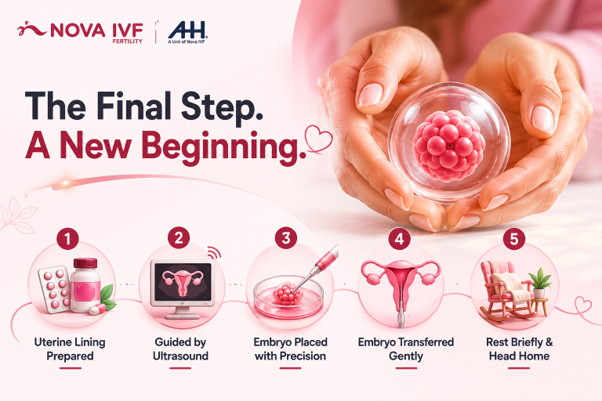
Embryo transfer is the final step of an IVF cycle. A fertilised embryo is placed into the uterus through a thin catheter, guided by ultrasound, and the whole thing takes around 15 to 20 minutes with no anaesthesia.
Most women find transfer day calmer than they expected. What stays with people is usually everything behind it: the weeks of preparation, the hormone support, and the decisions leading up to this one moment.
For most people, the 9 to 14 days that follow are harder than the transfer itself. This guide will help you prepare for both.
What Is Embryo Transfer and Why Does It Matter?
If the earlier stages of IVF are about creating a healthy embryo, the transfer is the moment that embryo is given its chance to grow into a pregnancy. Couples often ask why is embryo transfer needed as a separate step, and the answer is that the timing and conditions at this moment can shape the result.
Almost everything done earlier in the cycle is to support it. The lining thickness, hormone levels, embryo quality, and timing are all managed with the transfer in mind. Even so, implantation cannot be forced, and the best your care team can do is create the right conditions.
Types of Embryo Transfer: Fresh vs Frozen Embryo Transfer
Not every embryo transfer follows the same path. The two main approaches are a fresh transfer and a frozen one. Which type of embryo transfer suits you depends on your own clinical picture, and your doctor will guide that choice.
Fresh Embryo Transfer
A fresh transfer happens 3 to 5 days after egg retrieval, within the same IVF cycle. It suits women whose ovaries responded well, whose lining is receptive, and who have no concerns about raised progesterone or ovarian hyperstimulation syndrome (OHSS). In ICSI cycles, roughly 70 to 80% of eggs fertilise, though that reflects egg and sperm quality rather than the choice of a fresh embryo transport.
Frozen Embryo Transfer (FET)
In a frozen embryo transfer, the embryos are frozen after retrieval and placed in a later cycle, once the uterus has been hormonally prepared. FET carries a lower risk of ovarian hyperstimulation syndrome (OHSS) and often gives better uterine receptivity, since the body has had time to recover from stimulation. It is usually recommended when progesterone is raised, or the lining is thin at retrieval, and its success rates often match or beat fresh transfers.
While fresh embryo transfer treatment takes about 4 to 6 weeks for completion, Dr Rohit Gutgutia, a fertility specialist in Uttam Kumar Sarani, Kolkata, highlights a critical distinction that many patients miss: the hormone injections used to stimulate egg production can sometimes cause the uterine lining to mature too quickly, which can increase the risk of an early miscarriage during a fresh transfer.
To discuss whether a fresh or frozen transfer gives you the highest chance of a healthy pregnancy, visit our IVF centre in Uttam Kumar Sarani or any other Nova IVF fertility centre near you for a personalised evaluation with our fertility specialists
Step-by-Step IVF Embryo Transfer Procedure
The IVF embryo transfer may feel simple; however, each step has a definite clinical purpose. A specialist must talk you through everything as it happens. It usually involves:
- Preparing the uterine lining with hormonal medications
- A mock transfer, if needed, to map the uterine cavity in advance
- Embryo selection and loading into the transfer catheter on transfer day
- Placing the embryo under real-time ultrasound guidance
- A brief rest period at the clinic before discharge
From start to finish, the procedure itself usually takes about 15 to 20 minutes.
How Is the Uterus Prepared Before Transfer?
Estrogen and progesterone medicines are used to build the endometrial lining up to at least 7mm. Before the transfer date is set, your readiness is confirmed through an ultrasound lining scan and a blood test for hormone levels. Throughout your IVF treatment, the team monitors this closely so the uterus is in the best possible condition before the embryo is placed.
What Happens on Transfer Day?
On the day itself, you stay fully awake and comfortable throughout. You may be asked to arrive with a full bladder, which helps the doctor see the uterus clearly, and many women find it reassuring to watch the ultrasound. Afterwards, you rest briefly and head home the same day.
A common myth: Many women believe they must lie flat in bed for days after a transfer to protect the embryo. In practice, research has found that strict bed rest does not improve success and may, in fact, lower it. For most women, gentle everyday movement is completely safe.
Frequently Asked Questions
Is the embryo transfer procedure painful?
For most women, it is mild, a little like a routine pelvic examination, and no anaesthesia is needed.
How long after embryo transfer can I take a pregnancy test?
A beta-hCG blood test is usually done 9 to 14 days after the transfer for the most reliable result.
What is the difference between fresh and frozen embryo transfer?
A fresh transfer happens in the same cycle as egg retrieval, while a frozen one takes place in a later, separately prepared cycle. Both work well, and the choice comes down to your clinical factors.
What should I avoid after an embryo transfer?
It is best to avoid heavy physical activity, very hot baths or saunas, and major emotional stress. Your team will guide you based on your own treatment plan.